
What Is Domain Rating? a Founder's Guide to DR in SEO
What is domain rating? Learn how Ahrefs calculates DR, what a good score looks like, and how to read it alongside traffic, relevance and URL Rating.
By Free AI Directories Team · November 15, 2026

Domain Rating is Ahrefs' 0-100 logarithmic estimate of a website's backlink-profile strength, and it's a comparative link metric, not a Google ranking factor. It tells you how one site's backlink profile stacks up inside one tool's index, and nothing beyond that.
A shortlist of AI directories is easy to build and much harder to judge. Every name arrives with a score attached, some at DR 70 and some at DR 25, and the instinct is to sort the column and start at the top. That instinct is half right, and the half it gets wrong costs founders weeks of submissions that never pay back. The number compares backlink profiles. It doesn't measure readers, editorial standards, topical fit or whether a listing will ever be approved.
Table of Contents
- What Domain Rating Means for AI and SaaS Founders
- What a Domain Rating Score Actually Tells You
- How Ahrefs Calculates Domain Rating
- Reading Domain Rating Alongside Other Metrics and Its Limits
- Using Domain Rating to Choose Backlink Sources
- Checking Your Own Domain Rating
- How to Use Domain Rating Without Overtrusting It
What Domain Rating Means for AI and SaaS Founders
A founder shortlists two directories for a launch-week submission. The first is a well-known general site at DR 74 where every listing page links out to hundreds of products. The second is a niche AI directory at DR 31 whose listing pages carry a handful of outbound links each. The instinct says take the bigger number. The metric measures something narrower.
Domain Rating is Ahrefs' estimate of the relative strength of a website's backlink profile, expressed on a scale from 0 to 100. It compares domains inside one tool's index, so it works as a screening number for sorting a long list. The decision about whether to submit comes from other checks.
Back to the shortlist. The DR 74 site earned its score from a deep backlink profile, but each listing page splits its outbound value across hundreds of links, and your product sits in one row among many. The DR 31 niche site links to far fewer products per page, so a single listing there can pass more concentrated link value than the same listing on the higher-scoring site. Reading DR without asking how many outbound links a page carries is where the screening shortcut breaks.
Three common misreadings, each with a real shape:
- Treated as a Google ranking input. A directory can gain ten DR points while its own rankings stay flat, because the score is built from links inside Ahrefs' index, not Google's systems.
- Treated as a traffic signal. A DR 60 directory with almost no visitors will still display DR 60, and a listing placed there reaches no readers.
- Treated as a quality grade. A high-DR general site may publish listings without review, so the number alone says nothing about editorial standards or topical fit.
Founders meet the same number in three places: directory listings, outreach spreadsheets and backlink reports. For the wider sequence of earning links as an AI product, backlinks for AI tools lays out the practical order of work. Founders who want the search-visibility side explained alongside it can read this guide to AI SEO.
Once the score is read this way, any number on a list comes with a next action: check the page, count its outbound links and judge the fit before trusting the column.
What a Domain Rating Score Actually Tells You
A DR number is a rank inside Ahrefs' index; treat it as a screening signal before you treat it as proof. The Ahrefs glossary entry for Domain Rating frames it as an estimate of the relative strength of a website's backlink profile, with 100 at the strongest end. The useful word is relative.
The scale isn't linear
Because the scale is logarithmic, a point is not a point. Moving from DR 20 to DR 21 represents a much smaller increase in relative link strength than moving from DR 75 to DR 76. Ten points near the bottom can come from a handful of new referring domains. Ten points near the top can take years of outreach.
It works like a crowded leaderboard: the higher you climb, the more work each extra position demands. That property explains most of the confusion founders bring to the number. Comparing DR 41 with DR 44 means two sites sit close together in the index. Comparing DR 78 with DR 81 means one site took far more links to build than the other.
The practical read is simple. DR can sort candidates fast, but it cannot tell you which candidate deserves the pitch. A DR 44 niche directory with tight relevance and restrained outbound linking can be a stronger target than a DR 81 general site whose equity is spread across a much larger set of destinations.
The lookups founders make most
| Question | Short answer |
|---|---|
| What scale is DR on? | 0 to 100, logarithmic and relative to other domains in Ahrefs' index |
| Is DR 50 twice as strong as DR 25? | No. Equal point gaps do not mean equal strength gaps |
| Why treat close scores differently by range? | DR 41 to DR 44 is a small move; DR 78 to DR 81 is a much heavier lift |
| Does a high DR guarantee a strong link? | No. Use it to screen, then check relevance, followed status, outbound links and traffic |
| What DR should a backlink source have? | No fixed number. Compare candidates in your niche before judging the score |
Read DR as position, not permission. It tells you where a domain sits in one tool's index; the decision still belongs to relevance, dilution and the page that would carry your link.
How Ahrefs Calculates Domain Rating
The calculation is mechanical, and it follows a fixed sequence. Understanding the order helps you predict which links will matter and which will vanish into the noise.
The five steps in order
- Identify the followed links. Ahrefs finds every domain with at least one followed link pointing at the target site. A site that only ever linked to you with a nofollow attribute never enters this first step.
- Weigh each linking domain. A link from a domain with a stronger backlink profile contributes more than a link from one with almost none.
- Split the contribution. Each source's weight is divided among the unique domains it links to, so a site linking to thousands of destinations passes only a fraction of its equity to any single one.
- Count unique referring domains, not raw links. Extra links from a site already counted add nothing. The count is of distinct websites, which is why a hundred links from one blog behave like one link.
- Scale the result to 100. The raw figure is adjusted against every other domain in the database, which is why a score can drift when the wider link ecosystem changes, even if the site did nothing new.
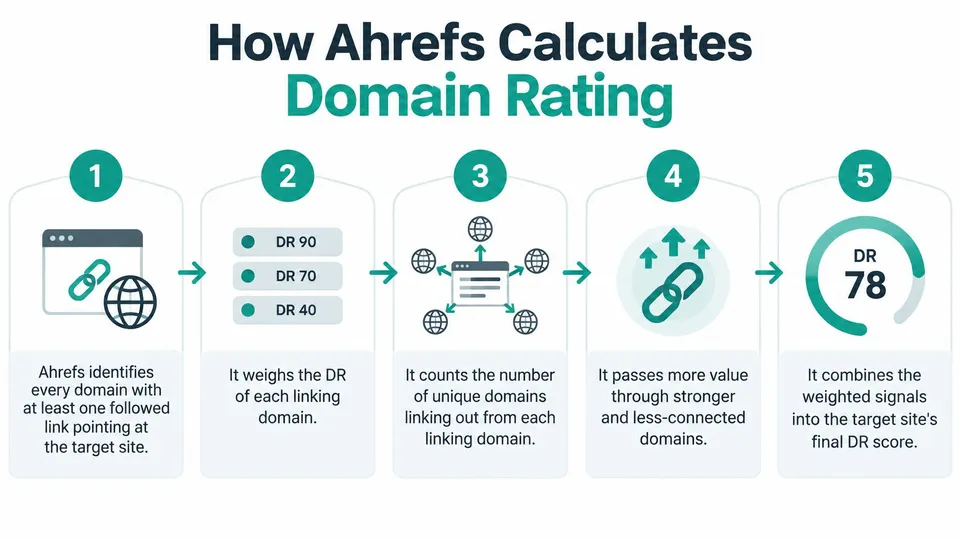
As Ahrefs' breakdown of Domain Rating puts it, link equity is diluted when a referring domain links to many different websites: a source doesn't pass unlimited influence because it holds a high DR. That one mechanic produces a counterintuitive result. A lower-scored site that links out to only a few domains can pass more calculated equity per link than a much higher-scored site that links to thousands.
What never enters the formula
Traffic, domain age and brand fame are absent from the calculation. The score comes from the structure and quality of followed links between domains, not from a site's search-traffic volume or how well known it is. A household-name publisher and a quiet specialist blog can land in similar territory if their link structures look alike.
What this means for outreach: one new link from a strong, relevant site can outweigh dozens from weak ones, and a brand-new referring domain counts for more than a second link from a domain you already have.
The tool can rank prospective domains by backlink-profile strength. It cannot promise listing approval, referral traffic, indexing or a ranking improvement.
Reading Domain Rating Alongside Other Metrics and Its Limits
Start with the number that keeps expectations honest. Ahrefs' 2025 analysis of DR against search rankings reported only a 0.131 correlation between DR and SERP rankings. A small positive relationship. It hints at direction, and it comes nowhere near carrying a decision alone.
A score can also move for reasons outside your control. Other domains gain links, the index shifts, the model changes, and your number slides while your own work continues unchanged. Founders who treat every dip as a failure burn weeks chasing a measurement artefact.
Checks to pair with Domain Rating
Each row below answers a question DR cannot.
| Check | What it adds beyond DR |
|---|---|
| URL Rating (UR) | Strength of the exact page that would host your link, not the whole domain |
| Referring-domain quality | Whether a site's own backlinks come from real, relevant sources |
| Organic traffic | Whether the site attracts readers who could actually click |
| Indexation | Whether search engines include the site's pages at all |
| Topical relevance | Whether the site's subject matches your product and audience |
| Referral conversions | Whether its links have already sent you users or signups |
Watch the table work on one candidate. A directory arrives with a strong headline score, then you walk it down the rows. The exact listing page carries a weak URL Rating because almost nobody links to it. The site's own backlinks trace to a cluster of unrelated domains rather than real sources. Organic traffic is thin, a share of its pages sit outside the index, its subject matter drifts from your product, and no signup has ever traced back to it. Six rows, five problems, one inflated number.
Run the same rows on a smaller niche directory and the pattern can invert: modest DR, a listing page that earns its own links, real readers, full indexation and a subject that matches your buyer. The checks decide which pitch deserves your afternoon, and the headline score only decides the order you examine them in.
Three myths worth retiring
- Myth one. A rising DR proves the link campaign worked. Google's spam policies for link spam define the practice as creating links primarily to manipulate rankings, and warn that when spam systems remove the effects of such links, earlier ranking benefits can be lost and may not return just because the links later change. A score can climb while rankings stay flat.
- Myth two. A link from a high-DR site is always valuable. A sitewide footer link, an irrelevant expired domain or an unattributed paid placement can each lift the number and add nothing. The signals are shifting toward usefulness: Ahrefs' DR4 testing notes describe more weight on linking sites and subdomains estimated to have organic search traffic, with stronger correlations reported for 10 million hosts in several comparisons.
- Myth three. DR 60 is twice DR 30. The scale is logarithmic, so the gap represents far more than double the link strength.
For a closer look at how directory links sit inside a wider search strategy, this guide to the SEO web directory explains where listings fit and where they don't. No provider can guarantee a specific DR increase, which makes the surrounding checks the one part of the process you fully control.
Using Domain Rating to Choose Backlink Sources
Now the decision the number was built for: which sites deserve a pitch. Three hypothetical illustrations show how the arithmetic plays out. They aren't measured results from real directories, and each shows a pattern rather than a specific site.
Scenario one. The big site with a small gift. A DR 80 news site links to thousands of domains and offers only a nofollow placement. A DR 28 niche directory links to a handful of sites, keeps listings followed and reviews submissions. The lower number is the better pitch, subject to verification. As Ahrefs' explanation of how DR is calculated sets out, a source splits its rating among the domains it links to, so outbound saturation decides how much any single destination receives.
Scenario two. The strong number on a stale site. A DR 55 general directory has listing pages that no longer render and updates that stopped years ago. DR can't see decay, so only a manual look catches it.
Scenario three. The nofollow listing that still earns its keep. A well-run, relevant directory marks links nofollow, or asks for rel="sponsored" on paid placements. Google's guidance on qualifying outbound links notes that links marked with these attributes generally won't be followed, although the linked pages may still be discovered through other means such as sitemaps or links from other sites. Referral traffic and discovery can still justify the twenty minutes.
Five checks in order
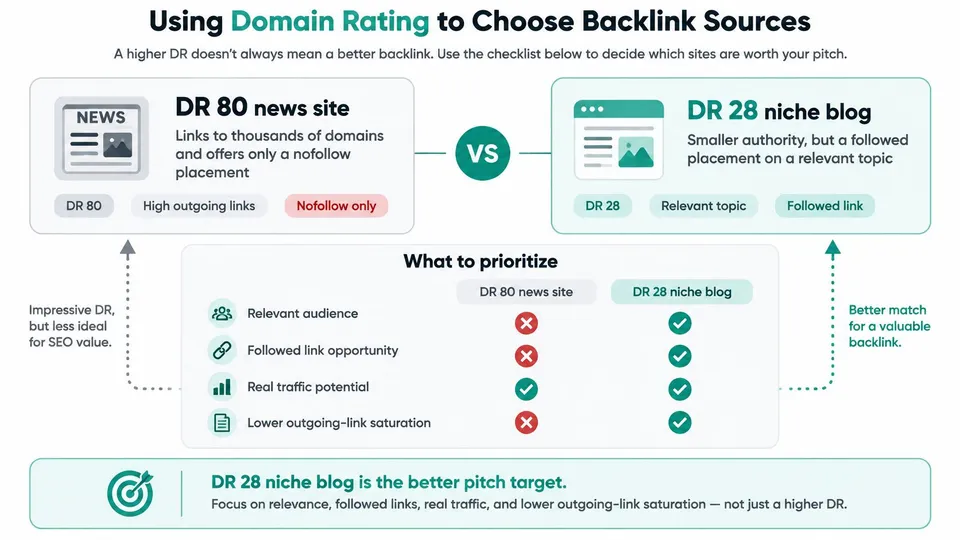
- Confirm the listing page is indexed. Search the exact URL. A page outside the index has nothing for a link to attach to.
- Check whether links are followed. If the placement is nofollow or sponsored, DR won't move and you're buying referral value only.
- Count how many other sites the directory links to. Heavy outbound volume spreads each contribution thin.
- Judge topical fit against the product. A page about AI writing tools beats a general business directory for an AI writing tool, whatever the scores say.
- Look for signs of maintenance. Recent additions, working pages and a real review process. A directory that stopped updating is a dead end.
Run them in that order, because a failed check on indexing or followed status ends the review early and saves you the rest.
Knowing which products sit beside yours matters as much as the link itself, which is why positioning and pricing against competing alternatives is worth reading before you choose directory categories. When you're ready to widen the field beyond directories, this comparison of backlink services covers how the options differ.
DR ranks the candidates. It cannot predict approval, traffic or rankings, and no honest reading of the metric pretends otherwise.
Checking Your Own Domain Rating
A new AI product site launches with almost no referring domains, so its own DR usually starts low. That's normal for a site with a short history and it says nothing about the product.
Open the tool that displays DR, enter your domain, then go to the referring domains report rather than the headline figure. The score is a summary of that list, and the list is where the decisions are: which domains link, whether those links are followed, and whether the linking sites have any connection to your category.
What actually moves your own number
New unique referring domains with followed links from relevant sites. The count of distinct domains is the lever, which is why a repeat link from a site already in your report barely registers. If your report shows the same three blogs again and again, the score has nothing new to work with.
Relevance decides how much each new domain contributes. A followed link from a focused directory with modest DR can outweigh one from a higher-DR general site, because each domain's contribution is divided across its outbound links and a niche site links out far less.
Monthly habit: record referring domains, organic traffic and signups on the same day each month. The trend stays visible even in months when the score barely moves.
The lever stays the same: new, relevant, followed referring domains. Buying or swapping links to inflate the count can lift the number temporarily, but links placed to manipulate rankings can be discounted entirely once detected, leaving the score back where it started and the spam exposure behind it.
Doing outreach by hand with a short list of relevant directories is slow but controllable, and often the better choice when your time is cheaper than your budget. Delegating it saves hours on forms and category decisions. Either way, export the referring domains report with each linking domain's DR, followed status and first-seen date, then compare it month over month. That file shows whether the work is landing.
How to Use Domain Rating Without Overtrusting It
Pick ten directories from your candidate list today. Run each one through five checks before you submit:
- Indexing: the directory appears in search results, so a link there can be found at all.
- Followed status: its links are dofollow, the only kind that counts toward DR.
- Outbound volume: every site a page links to takes a share of the value it passes.
- Topical fit: it sits inside your category rather than a general catch-all.
- Maintenance: recent approvals or updates show someone still reviews submissions.
Outbound volume is where the single number misleads most. DR measures the strength of a domain's backlink profile, and that strength gets divided among everything the page links to. A lower-DR niche directory listing only AI tools can beat a high-DR general site as a link source, because your listing joins a short queue instead of thousands of pages.
Then answer the budget question directly. If your time costs less than your budget, work the list yourself and keep control of the pitches. If the forms and follow-up would eat your build hours, hand them to a submission service, and hold that service to what it promises. Free AI Directories, whose free list covers 450+ curated AI directories, guarantees submissions and detailed reporting. It does not control directory approvals, and it does not promise specific Domain Rating increases, rankings, traffic or revenue.
The screening work above is already gathered in one searchable place, so your hours can go to submissions instead of spreadsheet research. Browse the list at Free AI Directories and put the five checks to work on your first ten candidates.
Ready to list your AI tool?
Get your tool in front of users across hundreds of AI directories.
Submit Your Tool →