SEO Web Directory Explained: Listings, Links and Value
Learn what an SEO web directory is, how listings work, and how to judge whether a directory is worth your time before you submit.
By Free AI Directories Team · November 9, 2026
The most repeated advice about an SEO web directory is to submit the product everywhere and wait for rankings. That advice treats each listing as a ranking token. It isn't one.
A directory sorts websites into categories so visitors can browse, and it publishes pages that search engines can crawl. A listing helps only when a person can find it and a crawler can reach it. A high domain rating and a long submission spreadsheet don't prove either of those things.
Founders of AI tools and SaaS products usually want three outcomes at once: visibility, backlinks, and users. A listing can deliver one and miss the other two. An unindexed page adds nothing a search engine can use. An indexed page in the wrong category sends the wrong visitors.
Before filling out forms, check whether the directory is moderated, indexed, and likely to send a relevant visitor. The checks below are written for a founder who has never measured a listing.
Table of Contents
- What an SEO Web Directory Is and How to Judge One
- Dofollow, Nofollow and Sponsored Links Explained
- How Listings Create Search Value and How to Track Them
- Which Directory Types Suit an AI Product
- Myths About Directory Backlinks and AI Visibility
- Decide Between Doing It Yourself and Hiring Help
What an SEO Web Directory Is and How to Judge One
An SEO web directory is a website that groups listings into categories. Visitors browse those categories to discover sites. Search engines crawl the category pages and the listing pages, then follow links out to the products that were submitted. A good listing works like a clear shelf label: it tells the crawler where the product sits and tells the visitor why to stop.
Human-sorted lists once carried real discovery weight. One directory-era history traces the arc: Yahoo began in 1994 as Jerry and David's Guide to the World Wide Web, the Open Directory Project (later DMOZ) passed 1 million URLs in October 1999 and reported 5,169,995 sites by April 2013, Yahoo shifted its main results toward crawler-based listings in October 2002, Yahoo shut its directory on December 31, 2014, and DMOZ closed on March 17, 2017. Today a directory works as a supporting channel for categorization and referral visits.
A huge catalog proves scale, and scale alone says little about one listing. The useful question is narrower: can a crawler reach the page, can a visitor find the product in a sensible place, and can you measure what happens after the click. A listing cannot promise rankings. It can earn a crawlable page, a fitting category, and a visit you can attribute.
Seven checks before you submit
Read each row against the directory you're considering. A single weak sign is enough to pause.
| Criterion | Strong sign | Weak sign | How to check |
|---|---|---|---|
| Moderation | Submissions are reviewed and weak ones are rejected | Everything is accepted instantly with no review | Read the submission guidelines and note the review process |
| Category relevance | Clear categories that match your product type | One catch-all category for everything | Browse the category your product would sit in |
| Indexing | Listing pages are public and appear in search | Pages are behind login, blocked or noindexed | Search the directory domain with site: and test a listing URL in Google Search Console |
| Audience | Recent listings and visible browsing activity | Stale entries and no sign of visitors | Check listing dates and compare referral visits after a test listing |
| Listing quality | Unique title and description for each entry | Duplicate or thin entries across many pages | Compare two listings from the same directory side by side |
| Business details | Accurate product name, category and links | Missing, wrong or outdated details | Review your own listing after it publishes |
| Longevity | Recent updates and working pages | Dead domain or abandoned sections | Check that pages load and when the directory last published changes |
Practical rule: Judge a directory by what one listing can do for a real visitor and a crawler; catalog size belongs in the background.
Say the product is an AI assistant for support teams. Open the category it would join. If the neighbors are unrelated coupon pages, the category fit fails, however old the domain looks. If the neighbors match the buyer and the page is indexed, you have something worth measuring.
Dofollow, Nofollow and Sponsored Links Explained
A link's HTML tells search engines how the directory treats that placement. The rel value is a hint, not a guarantee. Google later changed these attributes so they act as hints rather than absolute directives. None of them promises a ranking result.
| Attribute | Meaning | Ranking credit expectation | Typical directory use |
|---|---|---|---|
| No attribute | Standard link with no hint attached | May pass ranking credit | Unpaid listings with no special marking |
| rel=nofollow | Site does not endorse the destination for ranking | Hint only, ranking credit not guaranteed | Links the directory does not vouch for |
| rel=sponsored | Paid placement or advertising | Hint only, not an endorsement | Paid listings and featured spots |
| rel=ugc | Link created by users | Hint only, not guaranteed | Comments, forum posts and user submissions |
A standard link has no rel attribute. Search engines may pass ranking credit through it. rel="nofollow" says the site doesn't endorse the destination for ranking. rel="sponsored" is meant for paid placements. rel="ugc" marks user-generated links. Calling a directory "dofollow" from memory is a guess. The page you were listed on is the only evidence that counts, and that HTML can change after you submit.
Check the link on your own listing
- Open the directory page that holds your listing.
- Inspect the link, or view the page source.
- Look for the rel value on the link to your site.
- Record the result with the listing URL and the date.
A nofollow link can still bring visitors. Relevance and referral traffic still count when the category matches the product and the page is public. What doesn't count is describing a directory as valuable before anyone has looked at its current HTML and its submission policy.
Policies and markup change. Repeat the four-step check before anyone on the team calls that directory a source of SEO value. A screenshot from last quarter isn't current proof.
How Listings Create Search Value and How to Track Them
Search value from a listing follows four stages: a crawler fetches the page, a search engine indexes it, the link may pass ranking credit, and a visitor may click through. Skip one, and the later stages don't happen.
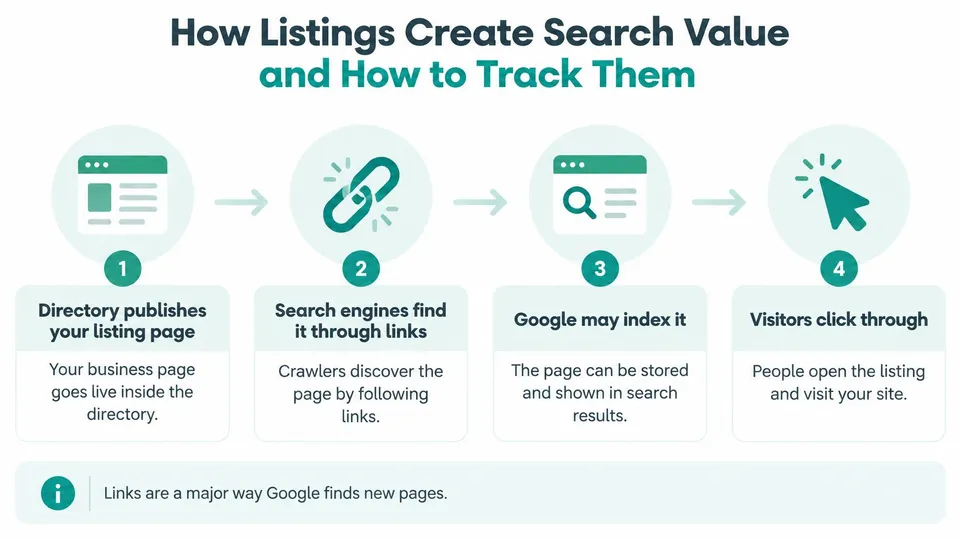
Google states that links are a major way it discovers new pages. A directory link is only useful for discovery when the listing page is public, linked from a crawlable category or detail page, and written with a distinct title and summary.
What blocks the path
Three blockers stop the middle stages.
Login walls: The listing exists only for signed-in users, so a crawler never fetches it.
robots.txt blocks: The directory tells crawlers not to fetch the listing path.
noindex tags: The page can be fetched, then the directory asks search engines not to store it.
Say two listings sit in the same directory. One has a unique description and a visible category page that links to it. The other sits behind a login. Only the first is likely to be found. The second works like a shop with a locked door: the sign is real, but nobody can walk in, and a spreadsheet can still mark it "submitted."
What to measure instead of a rating
Each stage has its own check. Confirm the listing URL in Google Search Console's URL Inspection tool and check that Google can fetch the page, which covers stage one. Indexed status covers stage two. Track indexed pages and referral visits separately, because they answer different questions. Where the directory allows a tracking parameter, use a UTM-tagged URL so analytics can separate that referral from everything else.
A directory link may generate referral visits even when it passes no ranking credit. A rank tracking API can show whether branded queries move after a batch, which is a different question from whether the listing page itself got indexed.
Keep a record you can edit later
Citation-audit guidance treats incorrect details, missing details, and duplicate listings as separate problems. An audit can show which record is primary so the duplicate can be removed. The same habit applies to software directories.
- Save the directory URL and the listing URL.
- Note the account owner, category, and description used.
- Record the submission date, status, and any duplicate or rejected entry.
- Store screenshots as proof.
Review indexed pages and referral sessions each month. Compare branded search and assisted sign-ups before and after a batch. When the product name or URL changes, that trail is how you find the listings that need an edit. If forms are eating a week, a free directory submitter workflow is worth reading before you scale past a test.
An unindexed listing that sends no visits has failed, however high the directory's rating.
Test one listing. Wait until you can see whether it was crawled, indexed, and clicked. Then decide whether more submissions are worth the time.
Which Directory Types Suit an AI Product
Pick two or three directory types where buyers already look, then submit only where a category matches the product exactly. Six types cover almost every pitch a founder will see.
| Directory type | Typically lists | Best fit | Main caution |
|---|---|---|---|
| General web directory | Sites across many topics | Broad brand presence | Often thin or unmoderated; check quality |
| AI tool directory | AI products sorted by category | AI products seeking users and category visitors | Many listings; confirm the visitors match your audience |
| Niche or vertical directory | Tools for one industry or role | Targeted referral traffic | Smaller audience; relevance is strongest |
| Local citation directory | Business name, address and phone | Businesses with a physical location | Rarely suits software products |
| Curated editorial list | Hand-picked tools with descriptions | Products that meet editorial standards | Harder to get accepted |
| Paid featured placement | Sponsored spot inside a directory | Visibility to people already browsing | Usually marked sponsored; judge by audience, not by link value |
A developer tool with a narrow use case fits a developer-focused niche directory better than a general list of thousands of unrelated sites. The niche list has a smaller audience. The visitors are closer to the buyer.
Local citation directories store a business name, address, and phone. They suit a company with a physical location. They rarely suit software that has no storefront and no local service area. Spending submission time there doesn't create a category a SaaS buyer browses.
Curated editorial lists ask for a real description and often reject thin entries. Paid featured spots put the product in front of people already on that site. Judge those by the audience, not by whether the link might pass credit. A sponsored label is normal for a paid spot.
Broad lists offer reach and a higher chance of weak pages. Niche lists offer relevance and fewer visitors. For most early AI products, one AI tool directory plus one niche directory is a better shortlist than five general catalogs.
Write a specific description before you apply. The guide on how to write a listing covers category fit and the details directories ask for. Confirm each directory's submission rules on its own site. A category name on a third-party roundup can be out of date.
Myths About Directory Backlinks and AI Visibility
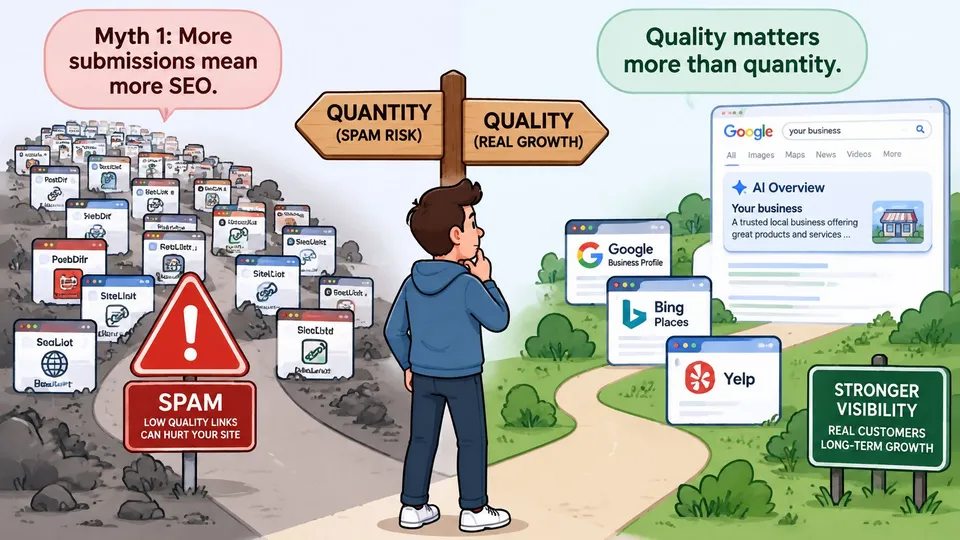
Myth one: more submissions mean more SEO.
Google's spam policy defines link spam as creating links primarily to manipulate search rankings. It names low-quality directory or bookmark-site links as a problematic pattern, and it warns against automated programs or services that create links. A bulk blast is not the same thing as a few listings prepared for specific directories.
The policy offers no percentage lift from submission volume, and it promises nothing about a directory link passing ranking credit. Hundreds of listings can produce no meaningful traffic if the pages are unindexed, irrelevant, duplicated, or buried in weak navigation. What counts is whether each listing page can be crawled, indexed, and found. Submission count measures workload, not visibility.
Myth two: a directory listing will put the product into AI answers.
According to Digiday's summary of the figures, more than 13% of Google queries triggered AI Overviews in March 2025, up from 6.49% in January; an Ahrefs analysis of 300,000 keywords found that queries with an AI Overview correlated with a 34.5% lower average click-through rate for the top-ranking page; and TollBit data showed AI search engines generated only 0.04% of publishers' external referral traffic in Q1 2025, while Google generated 85%.
Those figures describe publisher traffic and search result clicks. They say nothing about a directory's power to place a product inside an AI answer, and no submission can guarantee that placement. A listing adds a legitimate mention and some discoverability. That is the whole claim.
The fair test is simple. Before submitting, check that the directory's listing pages appear in Google's index. Then measure referral visits and branded search before a batch and again after it. If neither moves, more submissions won't close the gap. For a closer look at link quality versus link count, see this guide to backlinks for AI tools.
Decide Between Doing It Yourself and Hiring Help
Doing it yourself suits a founder who can read each directory's guidelines, write a description for that directory, and track results for several weeks. Managed submission suits a founder who would otherwise lose hours to repetitive forms, new accounts, and rules that differ on every site.
No provider can promise approval, approval timing, domain rating gains, or visibility in AI assistants. Each directory decides on its own schedule. Free AI Directories doesn't guarantee a directory's approval, timing, or continued publication of a listing. That limit is the trade-off, not a footnote.
Before paying anyone, check four things. Every submission should be made by hand. The report should name each directory, the status, and proof. You should keep the login details so you can edit listings later. Fixable rejections should be handled without a new fee. On completion of an order, the customer receives a detailed report listing every directory submitted to, the status of each submission, verification screenshots, and login credentials for the listings.
The free directories list shows each directory's domain rating (DR), whether it is dofollow, and whether it is free or paid, and it can be filtered, sorted, and searched. That is enough to build a shortlist without outsourcing the judgment. Broader search optimization advice from Verbatim Digital is useful when directory work is only one part of how the site gets found.
Pick five directories that pass the checklist. Submit one listing. Wait several weeks, then look at indexing and referral visits before you scale.
Free AI Directories keeps a searchable database of AI directories and offers paid, manual submission for AI products, with a report and login details after the work is done. If you're choosing directories for an AI tool and want listings you can verify, start with the public list. Visit Free AI Directories and shortlist a few directories before you submit anything.
Ready to list your AI tool?
Get your tool in front of users across hundreds of AI directories.
Submit Your Tool →