Best Backlink Services: How to Compare Providers Safely
Compare the best backlink services by method, pricing, transparency and Google risk. Learn what to demand in reports before you pay any provider.
By Free AI Directories Team · November 13, 2026
Most comparisons of backlink services answer the wrong question. They score providers on link volume, authority scores and delivery speed, then publish a ranking. Those numbers are easy to count, which is exactly why they appear in every list. They also tell you almost nothing about whether the money bought a link that exists, a link Google counts, or a link that put a site at risk.
A founder selling an AI tool doesn't need 300 links. They need to be findable when someone searches for a category, credible when a buyer checks the product page, and safe from the kind of paid placement that Google treats as spam. Those are three different purchases, and only one of them is a link in the ranking sense.
This guide splits the market by service type, prices each type per unit, and applies the same tests to all of them: unique referring domains, placement context, evidence, cost, policy risk and what can be measured in 90 days. It also says plainly when paying buys you nothing.
Table of Contents
- Backlink Service Types Compared at a Glance
- What Backlink Services Cost and Whether the Price Is Fair
- Criteria That Separate Strong Providers from Weak Ones
- Google Risk Rules Every Buyer Should Know
- How to Verify a Provider's Work Before You Pay
- How to Measure Results Over 30, 60 and 90 Days
- When a Paid Service Helps and When Doing It Yourself Wins
- Choose a Method and Set a Baseline Before You Pay
Backlink Service Types Compared at a Glance
No single provider wins for every founder, because the right choice depends on the goal. An AI tool that needs profile pages across product directories is solving a different problem from a funded SaaS team chasing editorial coverage in a category publication.
Provider lists also go stale fast. Directories close, agencies change hands, and a name that was solid last year can be reselling link packages this year. So the table below compares service types rather than brands, and it stays useful after the names change.
| Service type | What you typically receive | Main risk | Better fit when |
|---|---|---|---|
| Directory submission service | Listings in a set of directories | Thin links from low-value directories | You need listings and profile pages quickly |
| Guest post or sponsored placement broker | Articles or mentions on third-party sites | Paid links that break Google's rules when unqualified | You can verify each site and disclose sponsorship |
| Manual outreach agency | Pitches to editors and site owners | Results are hard to verify and vary widely | You have a story or resource worth covering |
| Digital PR | Press coverage and editorial mentions | Slow to earn and often costly | You have original data, news or research |
| Do it yourself | Listings and outreach you run and record | Your own hours | You have time and a clear target list |
Directory submission services take account creation, category selection and description formatting off your desk. The output is a set of profile pages, some of which get indexed and some of which never do. The risk is that volume gets sold instead of fit, and the founder pays for 200 listings when 25 were relevant. For a category-specific starting point, this guide to backlinks for AI tools shows where those placements come from.
Guest post and sponsored placement brokers sell articles or mentions on third-party sites. The article is rarely the problem. The link attribute is, because a paid placement sold with a followed link to move rankings carries real policy exposure.
Manual outreach agencies pitch editors and site owners on your behalf. Verification is the weak point: you get a placement list, not a record of the pitches that failed, and quality swings with whoever happens to run the campaign.
Digital PR earns coverage by giving a journalist something worth reporting, usually original data or a genuine news hook. It produces the strongest links of any type on this page and takes the longest to earn, often months. Doing it yourself delivers the same listings a paid package does, paid for in hours rather than cash, plus a record you fully control.
Every type is judged below on the same six things: referring domains, placement, evidence, cost, policy risk and measurement. Before reading on, answer one question. Which outcome is this purchase meant to serve?
What Backlink Services Cost and Whether the Price Is Fair
Directory packages are one-time payments with no recurring charges, so the useful comparison is total price against units delivered. The three published packages in this comparison scale the cost per submission down as volume rises.
| Option | Price | Units included | Cost per unit |
|---|---|---|---|
| 80-submission directory package | $99 one-time | 80 directory submissions | about $1.24 each |
| 200-submission directory package | $149 one-time | 200 directory submissions | about $0.75 each |
| 300-submission directory package | $199 one-time | 300 directory submissions | about $0.66 each |
| Survey average, one high-quality editorial backlink, 2025 | not a package price | 1 editorial backlink | $508.95 each |
The biggest package carries the lowest unit price, which is standard volume pricing. It is also the exact point where buyers stop checking whether the extra directories fit their product. Delivery scales the other way: published windows run 48 to 72 hours for the smallest package, four business days for the middle tier, and six business days for the largest. A lower unit price buys more work, not faster work.
Why a listing and an editorial link aren't the same purchase
Put a different asset next to those numbers. In 2025, the average acceptable price for one high-quality backlink was $508.95, based on a survey of SEO professionals covered in Emulent's analysis of link building costs. That's a survey of what practitioners say they will pay, not a market rate, and it describes a link on a third-party editorial site.
A listing is cheap because it's a form submission against a directory template, and it helps discovery when the directory has an audience. An editorial link costs more because someone researches a site, pitches an editor, writes for that audience and earns the placement. Paying $500 for a directory submission is a bad deal. Expecting editorial links at $0.66 each is a worse one.
What the price does and doesn't cover
The fair-price question is what the payment guarantees. The published terms cover manual submission, by hand rather than through bots or autofill, to every directory in the plan, plus a full report with proof of each submission and login details so the customer can edit the listings afterward. They do not cover approval, approval timing, ranking gains or traffic. Fixable rejections get resubmitted without an extra charge.
That scope matters for the math. The buyer is paying for completed work and evidence of it, which is a reasonable thing to buy when the alternative is repetitive forms and record-keeping done in spare hours. It stops being reasonable when the directories in the package have no audience for the product, because a guaranteed submission to an irrelevant site is still a submission to an irrelevant site.
The trade-off with doing it yourself is real. Cash outlay drops to zero, but the work is repetitive and the record-keeping is the part founders skip. If you can't name the directory, the listing URL and the date for each submission three months later, you've wasted the hours.
A package earns its price when it saves hours you'd otherwise spend and hands back proof of every submission. For a founder with time and a short list of relevant sites, submitting personally is the cheaper answer.
Criteria That Separate Strong Providers from Weak Ones
One published number sets the bar for every provider. A 2020 analysis of 11.8 million Google search results found that the first-ranked result had, on average, 3.8 times more backlinks than pages ranking in positions 2 through 10, and that the number of distinct referring domains was associated with higher first-page rankings too, according to Backlinko's 2020 study of Google ranking factors. The same study reported that domain-level authority tracked rankings more closely than the authority of an individual linking page.
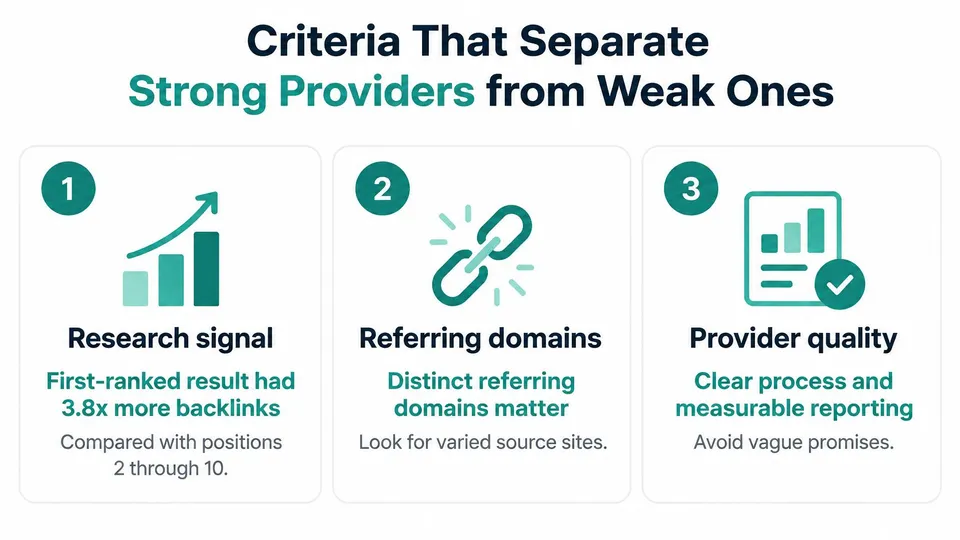
Read as buying criteria, those findings push the evaluation toward domains: how many independent sites a plan touches, how authoritative those sites appear, and whether the provider can name them before you pay. A provider who answers in specifics clears a bar most resellers cannot.
Eight checks that separate a real provider from a reseller
- Unique referring domains. Ask how many distinct sites are involved in a plan. Repeat links from one domain add little.
- Domain-level authority, treated as a proxy. Third-party scores help you compare prospects. Treat them as estimates, since Google publishes no equivalent metric.
- Topical relevance to your category. A project management AI tool gains more from a software review site than from a general business blog.
- Placement context. A link inside relevant copy carries a different meaning from one in a list of 200 unrelated sites.
- Disclosed link attributes. Followed, nofollow or sponsored should be stated per link, not averaged across a campaign.
- Natural anchor text. Google's guidance on crawlable links and anchor text recommends descriptive, concise text relevant to both pages, and warns that cramming related keywords into it breaks its spam policies.
- Indexing and live status. Both matter at delivery, and the verification checklist later in this guide shows how to confirm each one.
- A destination page worth landing on. A link that sends buyers to a thin product page wastes the placement.
The study shows association, and it cannot separate links from content quality, search intent, brand demand or technical SEO, all of which move the same results.
Weak proposals go vague on exactly these points, quoting volume where a buyer needs named sites and stated attributes. This comparison of directory submission services applies the same tests to the submission side.
Google Risk Rules Every Buyer Should Know
Start with the rule, because it decides which offers are usable. Google's spam policies classify buying or selling links for ranking purposes, automated link generation, excessive link exchanges, and optimized anchor text in distributed articles as link spam, per Google Search's spam policies. Paid advertising and sponsorship are allowed when marked rel="sponsored" or rel="nofollow", which means they pass no ranking credit.
| Placement or practice | Google's stated position | What to require from the provider |
|---|---|---|
| Paid placement marked rel="sponsored" | Permitted | Confirm the attribute in the page code and a sponsorship disclosure |
| Paid placement marked rel="nofollow" | Permitted | Confirm the attribute and treat ranking credit as unlikely |
| Paid guest post or advertorial with followed links | Link spam when sold for ranking | Walk away or require correct attributes |
| Links with optimized anchor text in distributed articles | Link spam | Natural anchor text such as the product name |
| Automated link generation or bot-based submission | Link spam | Manual submission with a record of each step |
What happens when the rule is broken
Google states that buying links or participating in link schemes to manipulate rankings can trigger a manual action affecting some or all of a site. Its remediation process involves exporting linking sites from Search Console, checking for links created recently or in volume, requesting removal or adding a qualifying attribute, then filing a reconsideration request with documentation, as described in Google's guidance on link spam and manual actions. A guarantee of ranking gains is a warning sign, not a feature, because no provider controls what Google decides after the fact.
The one test: would this link exist if it passed no ranking value? If the answer is no, it's a ranking purchase and it carries policy risk.
The usual trap is a guest post sold with keyword-rich anchor text and followed links. Three articles that each link the phrase "best AI project management software" with a followed link can look like editorial coverage while matching exactly what Google describes as link spam.
Ask each provider for the destination URL of every link, the link attribute as it appears in the page code, and a sponsorship disclosure wherever a paid placement applies. Free AI Directories states its submissions are manual and white-hat only, with no bots, no autofill and no spammy links.
How to Verify a Provider's Work Before You Pay
Link persistence is the quality problem nobody budgets for. Ahrefs reports that SEO professionals typically spend 1 to 2 hours building a single link, and its large-scale analysis found 66.5% of links to sites in its nine-year sample were dead, according to Ahrefs' SEO statistics analysis. Those figures set the bar for what a provider's evidence has to prove: placement happened, placement lasted, and you can check both yourself.
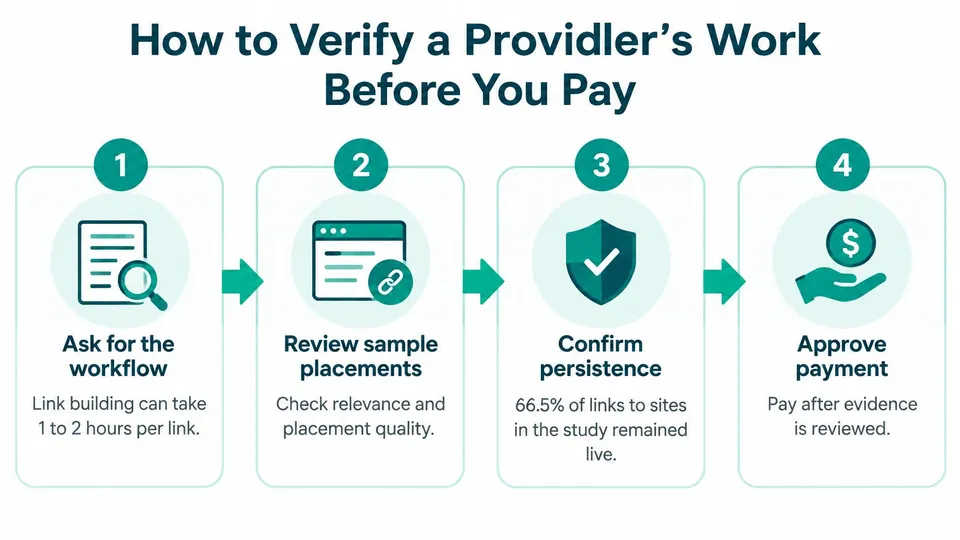
The checks below run in order. Each exists because of a specific failure that buyers discover only after paying.
Seven checks that turn a report into proof
- Require page-level URLs in the report. Failure to watch: a spreadsheet listing only root domains, which tells you nothing about where any link sits.
- Read the link attribute in the page code. View source on each page. Failure: a "dofollow" promise that shows rel="nofollow" once you look.
- Confirm the page is indexed. Search the exact URL. Failure: a live link on a page Google hasn't crawled. Google's SEO starter guide notes every page should be reachable through a link from another findable page, so check the directory page is reachable too.
- Find the link in the body. Failure: the link sits in a sitewide footer, inside a script, or on a page carrying hundreds of outbound links, where it passes little of anything.
- Record date, page topic and placement type. Editorial, user-generated and sponsored links age differently and count differently.
- Schedule persistence reviews at 30, 90 and 180 days. This catches removals and expired domains, which is how link rot shows up in practice.
- Require dated screenshots and a per-submission report. Screenshots taken on the delivery date are the cheapest evidence you'll ever get, and they survive any later dispute about what was delivered.
Some providers go a step further and hand over the login credentials for every listing they create. That detail matters more than it looks: if a placement later breaks or needs updating, you can fix it yourself instead of paying a second time for work you already bought.
A provider that can't supply a full URL list shouldn't be paid. That single demand filters out resellers who cannot name the pages they placed links on.
Keep the two schedules in this guide apart. The 30, 90 and 180-day reviews above answer a persistence question: do the links still exist? The review that follows runs on a different cadence and answers a performance question: did they help? Persistence is a check on the provider's work; performance is a check on whether the work was worth buying. Mixing the two produces arguments you can't settle.
How to Measure Results Over 30, 60 and 90 Days
Measurement is where backlink buyers get quiet. Industry commentary cited in recent link building statistics coverage reports that 52.9% of SEO professionals find link-building ROI difficult to measure, while 67.2% struggle to scale without losing quality. Both numbers point at the same gap: a list of URLs isn't evidence of anything.
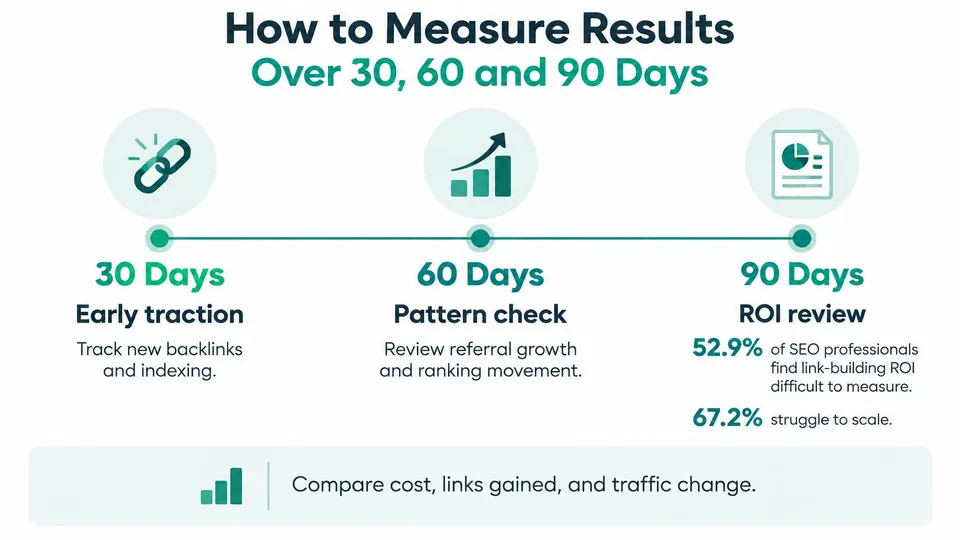
Separate four outcomes and track them independently. Indexed and live placement answers whether the work happened. Qualified referral visits answer whether anyone clicked. Assisted conversions answer whether those visits mattered. Organic ranking change against a baseline answers whether search visibility moved at all.
| Checkpoint | What to record | What it tells you |
|---|---|---|
| Day 0 | Referring domains, rankings for 2 or 3 target terms, referral traffic and sign-ups by source | Your baseline |
| Day 30 | Live and indexed status of each placement, referral visits from each linking site | Whether placements exist and send visits |
| Day 60 | Assisted conversions and branded search | Whether the links support discovery and credibility |
| Day 90 | Organic rankings against the baseline, removed or changed links | Whether any ranking change is real or noise |
Domain Rating movement is not proof of business impact, because third-party authority scores are proxies rather than Google measurements. A nofollow or sponsored placement can still send qualified referral visits, which is commercial value even when ranking credit is unlikely. Free AI Directories does not guarantee specific Domain Rating increases, rankings, traffic or revenue, and the same honesty is a fair thing to require from any provider you shortlist.
A flat result at 90 days isn't proof the links failed. For a new site with a small audience, 90 days is often too early to separate a weak campaign from a slow one.
When a Paid Service Helps and When Doing It Yourself Wins
Paying for help is right in some situations and a waste in others. The dividing line isn't budget. It's whether the service removes work you'd do badly or slowly.
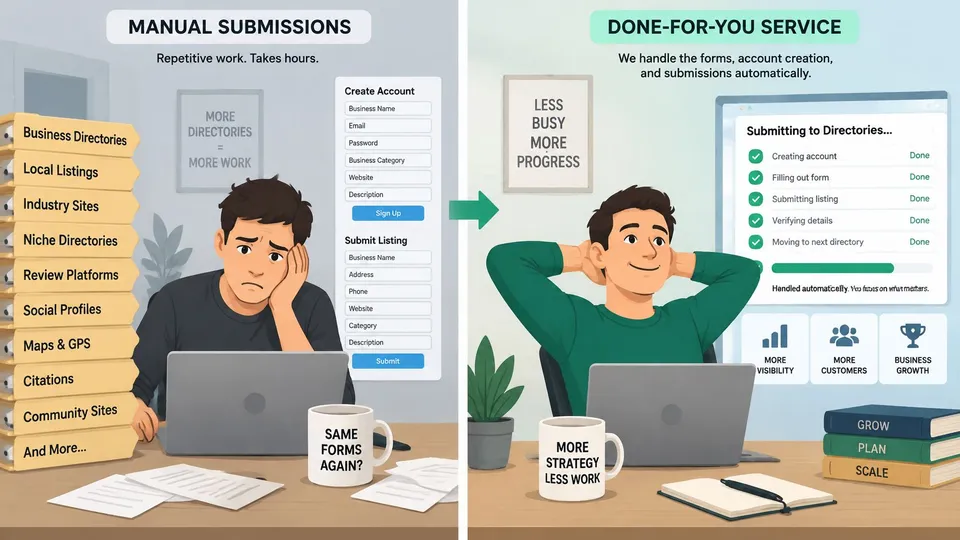
Budget but no hours, long directory list. Managed submissions remove account creation, category guessing and form filling across dozens of sites. That repetition is the main reason to pay, and it's worth it when your list runs past thirty directories.
Time and about twenty relevant sites. Do it yourself. Twenty submissions is a weekend of work with a decent template, cash cost near zero, and you keep control of the wording and the record.
A B2B SaaS team that needs editorial links. An outreach agency or digital PR retainer is the only route, and it's slower and costlier than any directory package. Judge it by named placements, not by link counts or a promised authority jump.
A new product with a thin page. No service fixes that. Improve the page and the listing copy first, because every placement points at the same weak destination.
Any provider guaranteeing a specific Domain Rating or a ranking position should end the conversation there. Consistent, crawlable listings across several sites are a reasonable bet, not a promise, and it's worth being clear about that. Free AI Directories publishes this guide and sells directory submission packages, so it has a commercial interest in your decision. Apply the same evidence standard to its offer that you'd apply to any other, and read up on free directory submitter options before spending anything.
Choose a Method and Set a Baseline Before You Pay
Work in this order, and the decision gets simpler.
- Write one goal. Listings, editorial mentions or ranking support. Pick one.
- Match the service type from the first table to that goal. A directory package can't produce editorial links, and digital PR won't fill in profile pages.
- Set the baseline today. Referring domains, rankings for two or three target terms, referral traffic and sign-ups by source.
- Ask for a sample report from each provider and run it against the verification checks above.
- Compare on cost per verified, live, relevant referring domain. Cost per submission rewards the wrong behavior.
- Put the 30, 60 and 90-day checks on the calendar before any work starts.
Test before you buy. Submit to five or ten relevant directories yourself, record each step, and watch the results for 90 days. That exercise tells you whether a bigger package is worth funding far more reliably than any ranking of providers will.
If you do decide to buy, the publisher here sells manual submission packages and also offers a free listing option, with tools submitted through a Free List or a Submit a Free Tool link. Check current details on its website rather than trusting a number you read in an article, including this one.
The rule the whole guide rests on is simple. Pay for evidence you can verify, not for counts or promised rankings.
If you want to test the low-risk end of this market first, Free AI Directories offers a free listing with a do-follow backlink and a free directory list you can sort by domain rating and dofollow status before spending anything. Its paid packages are manual submissions that come back with a per-directory report, verification screenshots and the login details for your own listings. Start with the free list, submit your tool to the directories that fit, and judge the paid option with the same evidence standard you'd apply to any provider.
Ready to list your AI tool?
Get your tool in front of users across hundreds of AI directories.
Submit Your Tool →