
Directory Link Building: How to Vet Directories in 2026
Learn how directory link building works, how to score directories for quality, and how to avoid spammy submissions in 2026.
By Free AI Directories Team · November 27, 2026
Most launch checklists tell SaaS and AI founders to submit their product to hundreds of directories in a single weekend, collect as many backlinks as possible, and watch their search rankings climb. That advice is backwards. Submitting everywhere in bulk rarely moves rankings, often leaves broken or mismatched profiles scattered across the web, and creates repetitive patterns that search engines treat as link spam.
A better way to approach directory link building is to treat every listing as a product citation you audit over time, not a backlink you count once and forget. Each listing puts your product name, URL, category, and description in front of real buyers and search crawlers. When those details stay accurate on vetted, relevant sites, they support discovery and trust. When they sit on neglected, catch-all link lists with pasted marketing copy, they waste founder time and add risk.
Founders don't need a massive spreadsheet of raw submissions. They need a clear scoring rubric to filter out weak sites, a clean manual workflow that avoids accidental spam signals, and a lightweight audit habit to verify what went live.
Table of Contents
- What Directory Link Building Delivers Today
- Paid, Sponsored and Free Listings Explained
- How to Score a Directory Before You Submit
- Submission Steps and the Spam Patterns to Avoid
- Track and Audit Every Listing After Submission
- A Worked Example of Choosing Two Directories
- Decide Whether to Submit Yourself or Hire Help
What Directory Link Building Delivers Today
Directory link building is the practice of listing a software product accurately on curated web directories that match its category and audience. Think of a directory listing as a street signpost rather than a ballot. A signpost points people and search crawlers toward your product page and confirms what your tool does. It doesn't cast an editorial vote of endorsement the way a journalist or industry writer does.
That distinction goes back to how link-based search engines were built. In the 1998 PageRank paper by Larry Page, Sergey Brin, Rajeev Motwani, and Terry Winograd, links functioned like academic citations, and a page's influence was divided across the number of outbound links it contained. Raw link quantity was never the whole model. Hundreds of links from obscure pages with hundreds of outbound links don't equal a single editorial mention from a respected publication.
Realistic Gains and Clear Boundaries
When a founder chooses relevant directories and fills out each profile carefully, four practical benefits are on the table:
- Crawlable discovery paths: Search bots follow live directory links to find new product pages, especially on young domains with few external mentions.
- Consistent branded citations: Repeating your exact product name, domain, and category across trusted sites reinforces basic entity details for search engines and readers.
- Targeted referral visits: Buyers browsing a niche category sometimes click straight through to try a tool that matches their workflow.
- Conditional authority signals: Depending on the directory's editorial standards and rendered link attributes, a listing may pass modest link value alongside those visibility gains.
The limits matter just as much. A link from a low-trust directory isn't comparable to an editorial feature on a relevant site, and no directory can guarantee listing approval, search rankings, referral volume, or a Domain Rating jump. Counting accepted URLs misleads founders because external links relate to rankings in a limited, non-deterministic way. Directories work best as a small foundational layer within a wider acquisition plan, similar to how Silva Marketing frames foundational profiles alongside editorial outreach in its guide to backlink strategies for local services.
Consider a simple illustration of what to expect, not a measured result. Suppose a founder launches an AI writing tool and submits it to a handful of focused writing and productivity directories. The practical payoff is a few referral visits from people comparing drafting tools and a clean set of accurate citations, not a sudden jump to page one. Even without a ranking spike, those early signals and visits are useful.
The reader test: Before submitting anywhere, ask whether the listing helps a real person find and understand the product.
Paid, Sponsored and Free Listings Explained
Paying for a directory listing isn't automatically a violation, and getting a free listing isn't automatically safe. The problem is an undisclosed followed link purchased to manipulate search rankings. Google's quality guidance has warned against link schemes since February 2003, and Google's December 2007 guidance on buying and selling links explicitly stated that buying or selling links to manipulate rankings violated its webmaster guidelines, while paid advertising links should be qualified with attributes such as nofollow.
Modern search guidance gives site owners specific HTML attributes to label commercial or user-submitted links clearly. Below is how each attribute works on a directory page and what to check once a listing goes live.
| Link attribute | What it signals | Typical directory use | Check after publishing |
|---|---|---|---|
rel="sponsored" |
Paid or advertising placement | Featured or paid listings | Confirm the attribute is rendered on the live page |
rel="ugc" |
User-generated content | User-submitted profiles or comments | Confirm the directory labels submitted entries |
rel="nofollow" |
Site does not endorse the link | Unvetted listings or declined endorsement | Confirm the attribute is present on the live page |
| No rel attribute | Editorial or standard link | Listings the directory vouches for | Confirm the link is present and not labelled otherwise |
According to Google's documentation on qualifying outbound links, rel="sponsored" belongs on paid placements, rel="ugc" applies to user-generated entries, and rel="nofollow" signals that a site doesn't want to imply endorsement. Google treats these attributes as hints rather than strict directives, yet they still communicate the commercial or editorial context behind the link. A directory that takes payment and publishes an unlabelled followed link carries a very different risk profile from one that labels paid spots transparently.
Weighing Paid Listings Against Free Submissions
Paid placements and free listings each come with clear trade-offs, and neither option fits every launch budget.
A paid placement can make sense when a directory attracts an active, relevant audience and labels sponsored spots properly. You might pay for faster review, category visibility, or a featured slot where prospective software buyers already browse. The downside is direct cost, and a properly disclosed paid link rarely adds ranking credit on its own. Treat paid fees strictly as an advertising expense for referral visibility, never as a way to buy authority.
Free listings protect early cash flow and can still deliver clean citations and occasional clicks when the directory stays well maintained. The trade-off is time and uncertainty. Free queues often move slowly, editorial standards may filter out thin profiles, and lower-visibility directories may send very few visitors.
Regardless of which route you pick, never assume a directory applied the attribute it promised on its pricing page. Open the published listing in a browser, inspect the anchor tag pointing to your site, and record the exact rel attribute rendered in the live HTML.
How to Score a Directory Before You Submit
Any directory that fails editorial purpose or topical relevance gets skipped immediately, no matter how high its Domain Rating looks. Third-party authority scores estimate backlink strength at the domain level, not whether a site reviews listings, serves your target users, or keeps its pages indexed.
A repeatable scorecard removes guesswork and keeps you from chasing vanity metrics. Rate every candidate directory across eight concrete criteria before writing a single word of listing copy.
| Criterion | Strong signal | Weak signal | How to check |
|---|---|---|---|
| Editorial purpose | Clear reason to exist, with listings reviewed | Accepts anything for a fee with no review | Read the submission rules and the about page |
| Topical relevance | Categories match your product type | Catch-all with unrelated categories | Browse two or three existing listings in your category |
| Listing page indexing | Listing pages load and are indexed | Errors or blocked pages | Search the site for the product name |
| Link attribute | Followed link, or clearly labelled sponsored or nofollow | Paid link with no label | Inspect the rendered attribute after publishing |
| Real user activity | Recent listings and updated categories | Stale dates and no recent entries | Check the dates of the newest listings |
| Submission rules | Clear requirements for description and logo | Identical copy required everywhere | Read the guidelines before writing |
| Ownership and stability | Stable domain serving its own content | Recent domain change or parked pages | Confirm the site still serves its own content |
| Domain Rating | One input among the rows above | Used as the only reason to submit | Compare with the rows above, never alone |
Running the Quick Pre-Submission Checks
You don't need an afternoon to score one site. Most checks take under five minutes if you run them in order.
Start with purpose and relevance. Read the about page and submission rules to see who curates the directory and why it exists. Then click into the category that fits your product and open two or three existing listings. If an AI analytics tool sits right next to local locksmiths or unrelated coupon codes, the site is a catch-all link dump.
Next, test whether listing pages work for search engines and users. Copy the name of a product already listed on the directory and search for that product name alongside the directory's domain in a search engine. If the listing page loads cleanly and appears in search results, indexing works. If pages throw errors, redirect elsewhere, or sit blocked behind a login wall, your listing won't provide a reliable crawl path.
Check freshness and stability right after. Look at the timestamps on the newest entries to see if editors still maintain the site, and verify the domain serves its own content rather than parked pages or a repurposed expired site. Read the formatting guidelines before drafting text so you know character limits, logo dimensions, and image rules upfront.
Domain Rating sits in the final row on purpose. When you use a Domain Rating checker, treat that score as one signal among eight rather than a green light by itself. As Wispra emphasizes in its quality backlinks guide for SMEs, topical alignment, editorial standards, and real audience utility matter far more than chasing a third-party number in isolation.
Skip any directory that fails two or more rows on the scorecard, and build your shortlist strictly from the sites that pass.
Submission Steps and the Spam Patterns to Avoid
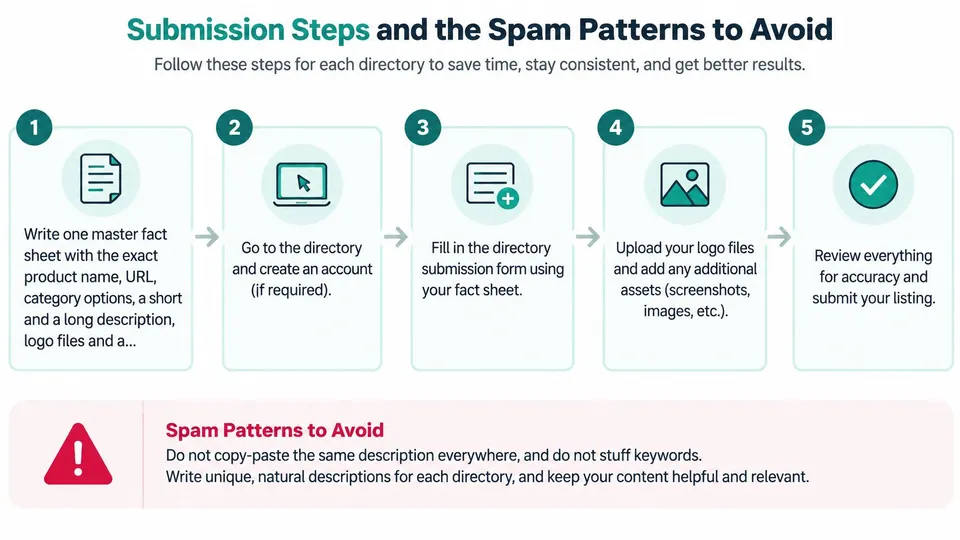
A directory submission works like a citation in a research paper. The reference only counts if the details are accurate, consistent, and placed where a reader would look for them. Rush the work, and you end up with the academic equivalent of misquoted sources scattered across footnotes. The visual workflow below summarizes the core sequence and the most common mistakes to steer clear of before you open a submission form.
Eight Manual Steps for a Clean Submission
Follow this exact order for every directory that makes your shortlist. Doing the prep work once prevents typos and keeps your citations consistent across the web.
- Build one master fact sheet: Put your exact product name, canonical homepage URL, target category options, a short one-sentence pitch, a longer product overview, properly sized logo files, and one dedicated contact email in a single document. Keep this file as your source of truth.
- Group your shortlisted directories by category: Work only from directories that passed the scorecard. Grouping similar sites together makes it easier to write accurate descriptions for each audience without switching mental gears.
- Rewrite the description to fit each directory's rules: Don't paste the same paragraph into every box. One site wants a concise feature list while another expects a plain-English use case, and pasted copy often breaks character limits or gets rejected by editors.
- Pick the single most accurate category: Choose the narrowest category that describes your software. Add a second category only when the directory explicitly allows multiple categories and your product serves both.
- Use your product name as the link text: Whenever a form lets you set anchor text, enter your exact brand or product name rather than a commercial keyword string.
- Submit by hand with one account per directory: Create one clean account using your dedicated submission email, fill out the fields manually, check the preview for formatting glitches, and save a screenshot or copy of the confirmation page.
- Log the submission immediately: Record the submission date, current status, account email, and confirmation or listing URL in your tracking sheet before moving to the next site.
- Wait for the editorial decision before making changes: Avoid submitting a second time while an entry sits in review. If an editor rejects the listing for a fixable issue, such as a mismatched category or a cropped logo, fix that specific item and resubmit once.
Notice how much of this sequence is paperwork rather than persuasion. That is deliberate. A listing you can audit later starts with records you keep now, and the confirmation screenshots from step 6 become your evidence if a page ever changes or disappears.
Seven Spam Patterns Founders Create by Mistake
The typical pattern starts with a habit, not a plan: a founder copies one polished description into form after form because it saved twenty minutes the first time. Shortcuts from outdated marketing threads do the rest, and the result is a footprint that looks manipulated even when nobody intended it. Google's spam policies classify links from low-quality directory or bookmark sites as link spam when they're created primarily to manipulate rankings, flagging repetitive anchor text, thin pages, and irrelevant categories.
Watch for these seven red flags across your submission work:
- Keyword strings in place of your brand name: Setting anchor text like "best AI writing software" instead of your product name turns every citation into an obvious ranking play, and a natural profile almost never looks that way.
- Directories built solely to host outbound links: Sites with no real browsing interface, no editorial review, and thin auto-generated pages offer zero user value and clear spam exposure.
- Categories chosen for broad reach instead of fit: Placing a narrow developer tool inside a general business or marketing category confuses visitors and signals careless mass submission.
- Unindexed or broken listing pages: Submitting to directories whose profile pages return server errors or never appear in search wastes effort and leaves dead trails.
- Bulk submission bots and autofill scripts: Automated form fillers mangle category selection, ignore site rules, and trigger spam filters on reputable directories.
- Reciprocal link demands as a listing condition: Directories that force you to add a badge or backlink on your own footer just to stay listed create unnatural link-exchange patterns.
- Duplicate entries filed while one sits in review: Resubmitting out of impatience produces near-identical pending listings on the same site, which reads as spamming the queue rather than following up.
One awkward entry on a marginal site rarely causes trouble on its own. A repeated pattern across dozens of listings, with identical phrasing, keyword-stuffed anchors, and unrelated sites, is what signals manipulation. Scale is the variable founders underestimate: the shortcut that felt harmless on three directories becomes evidence of intent at thirty.
Would this listing still make sense to a visitor if no search engine ever indexed it?
If the answer is no, skip the submission and put that time into product content or genuine press outreach instead.
Track and Audit Every Listing After Submission
A founder submits to thirty directories in one weekend, logs each date in a spreadsheet, and closes the tab. Three months later, that sheet still says thirty. In reality, twelve listings went live, four are still sitting in review queues, two were rejected for a mismatched description, and one directory folded entirely. The submission date proves nothing on its own, because a form entry is only a request in a queue. Until the page renders with your correct name, domain, and category, you have a pending application rather than a placement.
Treat each listing the way an accountant treats an invoice: it counts only after reconciliation. A structured audit sheet tracks every directory from initial submission through ongoing maintenance, and the visual checklist below highlights the core fields to verify once a submission goes live.
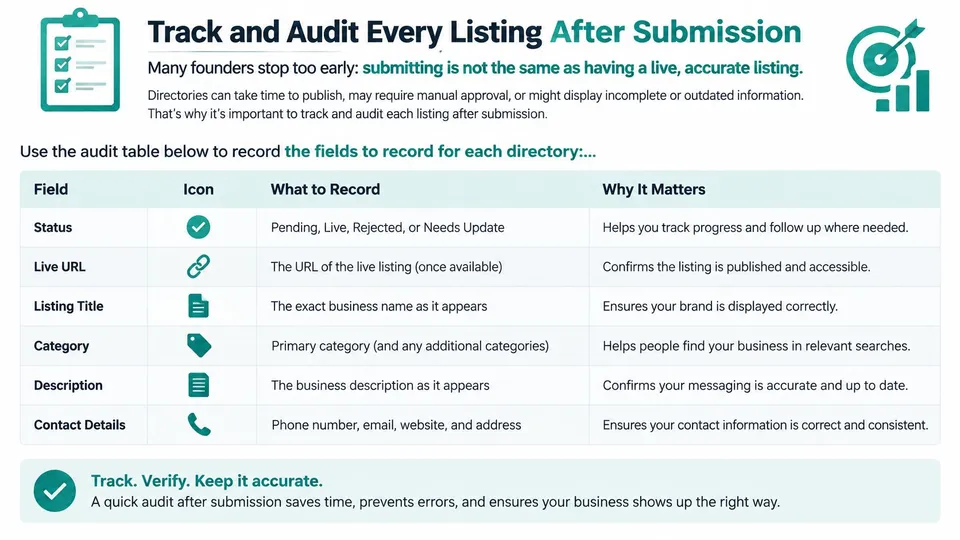
Keep these eight columns in your master tracker so every row reflects verified reality rather than assumptions.
| Audit field | What to record | Why it matters |
|---|---|---|
| Listing URL | Live address of the listing page | Proves the placement exists |
| Destination URL | Link target on your own site | Confirms the link points to the right page |
| Status | Submitted, pending, live or rejected | Separates real placements from queued ones |
| Name and URL match | Exact product name and domain shown | Catches wrong or outdated details |
| Category and contact | Category chosen and contact email shown | Prevents misrouted or unanswered listings |
| Rendered link attribute | Attribute present on the live page | Shows whether the link is labelled as sponsored or nofollow |
| Duplicate check | Number of listings for the same product | Flags conflicting duplicates |
| Last checked | Date of the most recent check | Shows when the next check is due |
Verification Checks and Fixing Conflicts First
Discovery and verification are two separate steps, and skipping the second is where most audit sheets rot. A search for your product name might surface a page on a directory domain, but that page could be a cached preview, a category archive, or a listing for a similarly named tool. Verification means opening the live URL yourself and confirming four things: the product name matches exactly, the canonical domain is the one you submitted, the category fits what you chose, and the contact email shown is current. Any row that fails one of those checks stays marked pending or incorrect, never live.
Apply a stricter standard than automated trackers do. Matching software often accepts a page when a percentage of the business details line up, which is useful at scale but generous for a portfolio of twenty or thirty listings you can check by hand in an afternoon. Open each URL, read the rendered description, and click the outbound link to confirm where it lands. A redirect chain ending on a parked domain means the link equity you counted on does not exist.
When an audit reveals stale descriptions, old domain redirects, or duplicate profiles, fix those errors before submitting anywhere new. Conflicting product names or duplicate pages split user trust and dilute the consistency that makes citations valuable in the first place. Even outside software niches, the cleanup discipline in Boocoo's breakdown of Brisbane small business citation cleanup illustrates why correcting inaccurate records and removing duplicates protects brand consistency over time. Expansion on top of a messy base multiplies the mess.
Measuring Referrals and Maintaining Your Portfolio
Once your live listings are verified, open your analytics and track referral traffic by directory domain. Raw click counts flatter weak placements. The more useful question is which directories send visitors who read product documentation, test a demo, or create an account, because a listing that sends two engaged visitors a month can outperform one that sends fifty bounces. Understanding how search engines discover and crawl new pages, covered in this guide to website submission for search engines, also helps you separate slow indexing from genuinely broken directory pages.
Directories are not permanent infrastructure. Site owners sell domains, change URL structures, shut down free tiers, or leave outdated pricing indexed long after you pivot your product. Set a recurring calendar reminder on a rhythm that fits your team, such as once a quarter, to re-check your live rows. Update stale copy, retire dead URLs from your active count, and email directory editors to remove unwanted or duplicate profiles.
A row earns its place in your active count only after passing a live verification check, and it keeps that place only as long as the checks keep passing.
A Worked Example of Choosing Two Directories
Two directories can look equally promising from the outside. Treat each one like a citation to audit over time, not a backlink to count once. The difference usually shows up in small details: how the editor describes the audience, whether the listing page can be found, and what happens after submission.
Suppose a founder launches an AI meeting-notes tool designed for remote engineering teams. While building a shortlist, the founder evaluates two candidate directories: Directory A and Directory B.
Directory A is a focused AI productivity catalog. Its about page states that editors review every tool before publishing, and its categories include a dedicated "Meeting Assistants" section. Clicking into three existing tools shows clean descriptions, working screenshots, and recent submission dates. Searching the site for one of those listed tools brings up the live profile page immediately. Directory A offers both a free queue and a paid featured spot. An existing featured listing shows rel="sponsored" cleanly rendered in the HTML.
Directory B looks stronger at first glance because its homepage leads with Domain Rating. The categories then tell a different story. AI meeting tools sit next to home renovation contractors, online casinos, and generic web agencies. The submission form demands a fixed, keyword-heavy blurb format and sells an unlabelled followed link for a fee. Two existing listings reveal one broken page and one profile that does not appear in search results at all.
Scoring Both Candidates Side by Side
The verdict is straightforward when the section 3 criteria are applied consistently:
- Directory A's scorecard: Keep. It has clear editorial purpose, topical relevance, indexable listing pages, transparent link attributes, real user activity, clear submission rules, and domain stability. Its Domain Rating is moderate, which does not cancel those passes.
- Directory B's scorecard: Skip. It fails editorial purpose, topical relevance, and listing page indexing, then adds an unlabelled paid link. The Domain Rating does not offset those problems.
The founder keeps Directory A, rewrites the meeting-notes description specifically for its "Meeting Assistants" audience, submits by hand, and logs the pending row in the tracker. Directory B goes into a separate tab as "Rejected during vetting: failed relevance, indexing, and paid-link disclosure." That note prevents a later round of review from treating a weak fit as a fresh opportunity.
This illustration sets expectations as much as it ranks the two candidates. A pass means the directory is worth a submission attempt. It does not mean approval is guaranteed, review timing is fixed, referrals will arrive, or rankings will move. A listing works like a citation that needs checking again later, especially if the page changes, the editor removes it, or the directory shifts its rules.
The same process applies when the shortlist is short. Finding only three directories that pass is still a useful outcome. Three accurate, relevant citations give the founder a cleaner base than a long list assembled from impressive-looking metrics and repeated copy.
Decide Whether to Submit Yourself or Hire Help
The choice is who can keep every citation accurate enough to audit six months from now. A directory listing behaves like a reference entry: if the category is wrong, the description is copied everywhere, or nobody can log in later to fix it, the citation gets weaker even when the link stays live.
Doing the submissions yourself costs zero dollars in service fees and gives you direct control over every category choice, screenshot, and sentence of product copy. When your shortlist holds only ten or fifteen relevant directories, doing it yourself over a couple of focused afternoons is usually the smarter option. You learn how each directory positions competitors, and you avoid paying for administrative work you do not need.
Outsourcing becomes practical when your vetted list grows large and founder hours are better spent shipping product or talking to customers. Filling out dozens of distinct forms, creating separate accounts, resizing assets, and tracking confirmations eats up days of engineering time. Free AI Directories maintains a free directory list and sells done-for-you human submissions starting from $99.
Before paying any service to handle submissions, judge whether the work will produce citations you can audit later, not merely links you can count. The same lens helps when evaluating backlink services. The baseline is already clear: human work, no automation, and guarantees limited to the provider's own labor. The remaining checks are more specific:
- Copy shaped to each directory: Descriptions should be adapted to each directory's format, category rules, and audience, because identical pasted text is one of the spam patterns founders create without noticing.
- Evidence plus account control: Reports should document each submitted directory with proof, and login credentials should be handed over so you can edit, correct, or retire listings later.
- Clean rejection repair: Fixable rejections should be corrected and resubmitted cleanly, with the cause logged so the same formatting or category mistake does not repeat across the queue.
Do not overthink the whole campaign today. Pick five directories in your product's category this week, run each one through the eight-row scorecard, and log your results. Once you see how long five real submissions take, you will know immediately whether to keep the work in-house or hand the manual queue to a provider.
If you want a curated starting point for vetting relevant AI sites or prefer to hand off the repetitive form work without touching automated tools, Free AI Directories combines a searchable directory list with manual, white-hat submission packages that include custom copy, proof of work, and full account credentials. Explore the directory list or review the manual submission options at Free AI Directories.
Ready to list your AI tool?
Get your tool in front of users across hundreds of AI directories.
Submit Your Tool →