Free Website Submission for AI and SaaS Tools
Free website submission for AI and SaaS founders: choose relevant directories, skip paid forms, and track live listings instead of raw counts.
By Free AI Directories Team · November 22, 2026

Submitting a product everywhere isn't a visibility strategy. A founder can spend an afternoon filling out directory forms and still find no trace of the product in search the next morning. The mistake is counting completed forms as distribution instead of checking whether a relevant listing brought anyone to the product.
For AI and SaaS founders, free website submission should be a measured funnel, not a contest to collect submission confirmations. A useful directory deserves attention because potential users browse it, not because its form accepts a URL.
Table of Contents
- What Free Website Submission Can and Cannot Do
- How to Submit Your Website Without a Fee
- Directories Worth a Free Submission
- When a Submitted Site Still Cannot Be Found
- Submit It Yourself or Hand the Forms Off
What Free Website Submission Can and Cannot Do
Free website submission means offering a website to a directory or similar platform without paying a listing fee. For an AI tool or SaaS product, the useful outcome is a relevant place where a buyer can discover and evaluate the product. Sending the form is only the starting action.
A directory submission isn't the same as submitting a sitemap, creating a social profile, or building links. A sitemap helps search engines discover pages. A social profile establishes another public presence, while link building concerns links pointing toward the product website.
According to Google's crawling and indexing documentation, search involves crawling, indexing, and serving results, and a sitemap doesn't guarantee crawling or indexing. A directory form provides even less control over those stages.
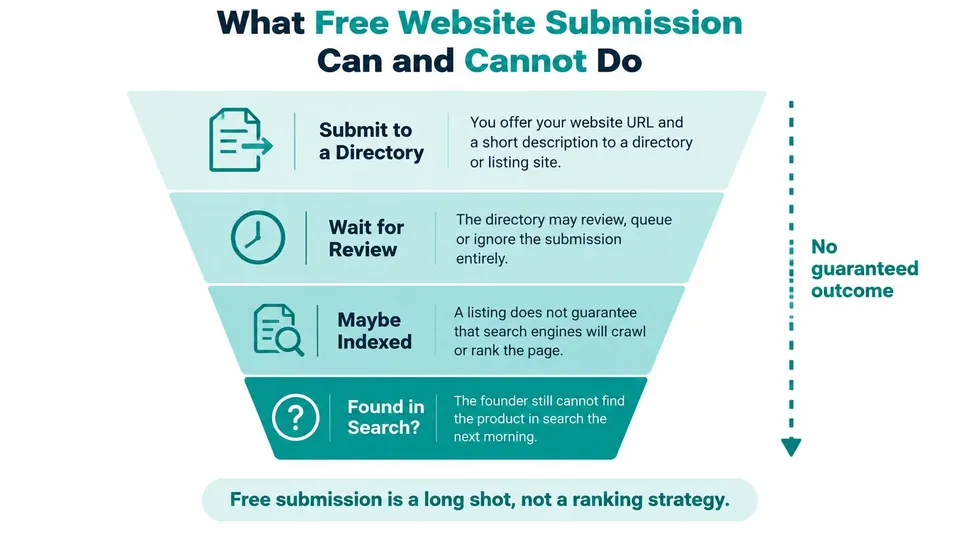
Choose the outcome before completing the form
A founder seeking users should measure something closer to product use than administrative completion. Qualified signups make a stronger business measure than submission count, although intermediate checks help explain where progress stopped.
What each free submission action produces
| Outcome | What it confirms | What it does not prove |
|---|---|---|
| Form sent | The directory received a submission | Approval, a public page, or a ranking change |
| Live listing | A public page shows the product | That the page is indexed or sending visitors |
| Indexed listing page | A search engine has indexed that listing URL | A higher ranking or a mention in an AI answer |
| Referral visit | Someone clicked from the directory | That the click came from a valuable link attribute |
| Qualified signup | A visitor from that listing became a user | That more directory forms will repeat the result |
These outcomes need separate records. A backlink, a ranking improvement, and a mention in an AI-generated answer aren't interchangeable wins. Founders assessing link opportunities can use this guide to getting backlinks for an AI product without confusing link acquisition with customer acquisition.
Fix the constraint rather than increasing volume
More submissions won't repair a blocked product page. They also won't resolve a mistaken canonical tag, duplicated content, or a landing page that barely explains the product.
Practical rule: A submission is an action under the founder's control. Publication, indexing, and customer response aren't.
The sensible starting point is a technically accessible product site and a maintained directory database, not an old spreadsheet full of dead domains. Preparation and verification matter more than how quickly someone can paste the same description into another form.
How to Submit Your Website Without a Fee
A repeatable process keeps free website submission from consuming an open-ended amount of development time. The work should leave behind usable assets, company-controlled accounts, and a record another team member can understand.
The sequence below separates directory research from form filling and follow-up. That separation prevents a common failure: finishing a submission session without knowing which entries were valid or where the credentials went.
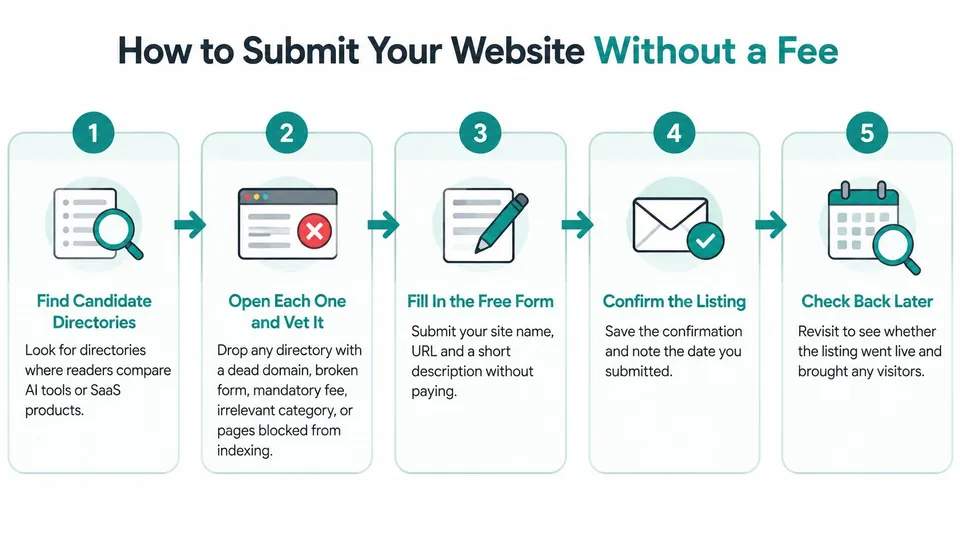
Prepare the destinations and source material
Find candidates where buyers compare products, then remove unusable destinations before writing listings. Relevant categories should contain AI tools or SaaS products serving a recognizable need. A dead domain, broken form, mandatory fee, unrelated category, or blocked listing page is a reason to stop, not troubleshoot indefinitely. A promising directory should pass the keep-or-drop checks before entering the submission queue.
Build a source sheet so product facts don't drift between forms. It should contain the product name, canonical URL, short value proposition, primary category, contact details, and privacy or terms URLs where required. The description should identify the user, task, and useful result. For example, an invoice-processing tool needs a clear explanation of what it extracts and where the output goes, not a collection of adjectives about productivity.
Prepare real product images before opening submission forms. As an asset-preparation baseline, Google's merchant-listing documentation recommends high-resolution product images in 16:9, 4:3, and 1:1 aspect ratios, with at least 50,000 total pixels, calculated as width multiplied by height. These are structured-data recommendations, not universal directory requirements. Logos and screenshots should represent the actual product, use public image URLs, and be adapted to each directory's own constraints.
Create accounts with a company-controlled email address and save access before submitting. A personal inbox belonging to a departing contractor creates an avoidable ownership problem. Credentials belong in a company password manager, with an access reference in the tracking sheet. Publicly shared submission reports shouldn't expose passwords.
Submit accurately and preserve the evidence
Adapt the description and category to the directory's readers without changing the underlying facts. A developer directory may need integration details, while a business-software category may need the workflow explained in plain language. The submitted destination should be the canonical product URL, not a temporary campaign page. Keyword repetition and inflated claims make a listing less useful to both editors and prospective users.
Record the submission immediately because an unsaved confirmation is difficult to reconstruct later. The log should include the directory name, account email, submission date, status, listing URL when available, and a confirmation screenshot. Pending, rejected, and published should remain distinct statuses. A screenshot proves what appeared during submission, not that the directory later approved it.
Keep the product website ready for discovery rather than relying on directory administrators to solve technical problems. The homepage should be reachable, and the sitemap should reflect current public pages. Applicable Organization structured data should be validated with the Rich Results Test; Google's Organization documentation notes that recrawling and re-indexing after deployment can take several days. URL Inspection can help an authorized site owner assess access problems and request recrawling when appropriate.
Verify publication and measure movement
Schedule publication checks and maintenance rather than assuming the confirmation ends the job. A practical cadence is a check 7–14 days after submission, followed by quarterly reviews for URL, pricing, category, and ownership changes, consistent with the listing-maintenance guidance accompanying BrightLocal's business-listings trust report. The saved record should show both the latest check and any correction still awaiting action.
Report each funnel stage separately so administrative output doesn't hide weak results. The report should distinguish valid submissions, live listings, indexed listing pages, referral visits, and qualified conversions. Referral reporting should connect visits to a meaningful product event, such as completing onboarding or using the core feature. When a directory sends visitors who never reach that event, the next task is to examine audience fit and the landing page, not automatically submit elsewhere.
Directories Worth a Free Submission
A directory deserves time when its readers could plausibly need the product. Free entry alone isn't a reason to proceed. An inactive directory with an unrelated audience can consume as much administration as a relevant placement.
The strongest comparison isn't between directories with impressive-looking metrics. It's between a destination that helps a buyer evaluate the product and a destination that exists mainly to accumulate outbound links.
Apply a keep-or-drop test
Keep or drop a free directory
| Check | Keep it when | Drop it when |
|---|---|---|
| Site and form | The domain loads and the form can be completed | The domain is dead or the form is broken |
| Audience | Readers are evaluating AI tools or SaaS products | The category is unrelated or a junk pile of unrelated sites |
| Price | A listing does not require a submission fee | Payment is mandatory to be listed |
| Visibility | The listing page can be crawled and is not behind a login wall | The page is blocked with noindex, robots rules, or a required login |
| Link context | The listing is editorial, or a paid placement is qualified | The site exists mainly to pass ranking signals |
| Control | An account allows later listing edits | The listing cannot be corrected or removed |
Google's link-spam policy identifies low-quality directory links and automated link-creation programs as spam examples when used to manipulate rankings. It also permits paid or sponsored links when appropriately qualified with attributes such as rel="nofollow" or rel="sponsored".
That distinction matters. A nofollow listing can still provide referral traffic or brand discovery. A link commonly called dofollow isn't automatically valuable, and a paid placement belongs outside a fee-free submission queue even when its link handling is acceptable.
A useful listing helps someone choose a product. An unqualified backlink count doesn't establish that anyone had a reason to click.
Judge relevance at the buyer's task level
Category labels aren't enough. A career-focused AI tool belongs near readers evaluating job-search workflows, while an infrastructure product needs a different audience. For career-product founders, Interview Pilot's top job search sites compared offers context for considering the discovery destinations their intended users evaluate.
The directory record should capture current status, topical fit, audience geography, approval rules, canonical destination, link attributes, referral visits, and date last checked. A founder shouldn't have to repeat the same research whenever the team revisits a listing.
Duplicate entries should be merged or removed when they conflict. Obsolete listings should be corrected or retired, and a dead or irrelevant directory can be removed from the company's active resource references. A weak-looking link alone isn't a reason to launch an indiscriminate removal campaign.
Manual selection takes longer than mass submission. That's a reasonable trade when it prevents irrelevant placements and preserves an editable record. A guide to finding open directories provides a research starting point, but current forms, fees, and publication rules still need checking before submission.
When a Submitted Site Still Cannot Be Found
A submitted URL can fail at several points: the form may not have gone through, the directory may still be reviewing the listing, or the published page may not appear in search. Check the stage before repeating the work. A missing directory listing and an unindexed product homepage need different fixes.
Diagnose the first failed checkpoint
Submitted but missing: cause and next check
| What you see | Likely cause | Next check |
|---|---|---|
| No confirmation email or screen | The form may not have gone through | Check the account dashboard and email delivery before resubmitting |
| Pending or in review | The directory has not approved the listing yet | Keep the confirmation and wait for a decision |
| Live page, not in search | The page may be blocked, duplicated, thin, or not yet crawled | Check robots, noindex, canonical, access, then URL Inspection |
| Search shows old copy | The directory page has stale details | Edit the listing using the saved login and record the date |
| Two listings disagree | Details came from different versions of the product record | Correct both from the approved source of product details |
Treat each cause as a hypothesis to check. A missing confirmation can come from email delivery, so check the account dashboard before submitting again and creating a duplicate. A page that does not appear for one search query may still be indexed.
URL Inspection requires access to the relevant property. You can inspect your product website if you have access. For an independently owned directory, document the issue and contact its administrator; you usually cannot inspect the directory's property yourself.
Correct stale information at its source
Listing errors need a clear correction process. Netimperative's coverage of BrightLocal consumer studies reports that 85% of consumers had found incorrect or incomplete business-listing information during the previous year.
For software listings, check for practical errors: a broken product link, outdated pricing, the wrong category, or a description of a feature the product no longer has.
- Broken destination: Replace the URL and update the source record.
- Stale description: Edit the directory listing through the saved account and record when you changed it.
- Conflicting details: Reconcile both listings against the approved product record.
Keep the directory name, listing URL, submitted details, account-access reference, and open fixes in one tracking record. This will not create traffic on its own. It lets you identify what needs correction and whether a placement is bringing relevant visits.
For the product site, this guide to submitting a website to search engines covers site discovery separately from directory administration. Count a directory placement as useful only when it produces a live, relevant page that can be found and visited.
Submit It Yourself or Hand the Forms Off
DIY is the right default for a short, verified list. A founder with a handful of suitable destinations doesn't need to buy a service to enter product details. Keeping the work inside the team also makes early editorial feedback easier to understand and apply.
The condition is ownership. Someone must control the accounts, maintain the source sheet, and carry out the scheduled reviews. Free submission removes a listing fee, not the cost of the team's time.
Keep strategy with the product team
A founder should decide which users matter, what the product does, and where it belongs. Those decisions are too important to outsource as incidental form fields. Administrative help becomes useful after the destinations and product positioning are settled.
- Stay with DIY when relevance is still uncertain. Reading categories and responding to editor questions can expose weaknesses in the product description.
- Delegate when administration is the bottleneck. Repeated account creation, formatting, and evidence capture can be handed off without surrendering destination selection.
- Keep an internal owner in either case. External help doesn't remove the need to approve claims, protect credentials, or update changed product details.
A founder losing development days to repetitive forms has a different problem from a founder who hasn't identified suitable directories. Only the former has a clear reason to pay for execution.
Delegation test: The task is ready to hand off when another person can complete it accurately from the approved source sheet and destination list.
Buy documented work rather than promised outcomes
Free AI Directories offers a Free Listing for $0, with a lifetime listing within 24 hours and a do-follow backlink in its own tools directory; its done-for-you human submissions start at $99. These are separate offers: the former concerns its own directory, while the latter pays for manual submission work across selected destinations.
For managed work, Free AI Directories adapts descriptions to directory requirements and provides submission evidence and login details. The submission report lists what was submitted, not guaranteed live links, because approval and indexing take time. A founder should review that distinction before treating a completed order as a set of published placements.
Neither DIY nor delegation promises rankings, domain-rating gains, or visibility in AI assistants. The decision should turn on workload, control, and the usefulness of the handover, not an assumed search-performance lift.
The practical recommendation is straightforward: a founder with a short verified list should submit directly. A founder with chosen destinations and an administrative backlog can consider paid help, then review the statuses, screenshots, credentials, and outstanding follow-ups.
Free AI Directories offers a searchable directory database for researching relevant destinations and manual submission services for founders who need help with the forms. Visit Free AI Directories to check current directory information, build a selective shortlist, and choose between submitting directly or handing off the administration.
Ready to list your AI tool?
Get your tool in front of users across hundreds of AI directories.
Submit Your Tool →