
Directory Submission Meaning: A Plain-English Guide
Directory submission meaning explained in plain English: what a listing is, how reviews work, why AI and SaaS founders use them, and what to avoid.
By Free AI Directories Team · November 25, 2026
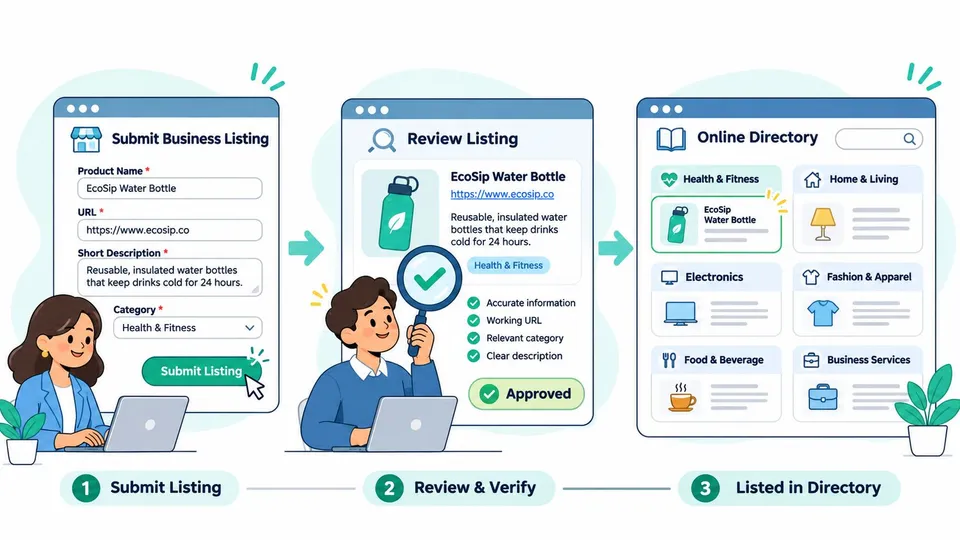
Directory submission means sending your product's name, URL, short description and category to a categorized web directory, where it's reviewed and may be listed. It's a request for consideration, not a promise of acceptance, ranking or traffic.
So why do founders who submit to hundreds of directories still struggle to get found, while a competitor with a handful of listings pulls in steady signups? The gap usually isn't volume. It's fit. A directory is a catalog first and an SEO asset second, and the catalog only helps when a person browsing the right shelf sees the entry. That reframing changes what a founder does next: fewer forms, better fields, closer categories. Understanding the directory submission meaning in that order, cataloguing before links, keeps a launch week from turning into a month of copy-paste with nothing to show for it.
Table of Contents
- What Directory Submission Means in Plain English
- The Parts of a Directory Submission
- How a Submission Moves From Queue to Listing
- Why Founders Submit and What It Really Returns
- Telling a Legitimate Directory From a Link Scheme
- Decide Whether to Submit Yourself or Use a Service
What Directory Submission Means in Plain English
A directory is a curated list organized into categories, usually by people. As this guide to the directory era explains, a submission proposes a site or digital product for inclusion, and an editor then reviews, revises, approves, rejects or queues the entry. The submitter supplies structured information so someone else can classify it and make it findable.
Think of a library card catalog. An author files a card with the title, subject and shelf location, and a librarian decides where the book belongs. Nobody hands the author a shelf slot on demand. The card is a proposal, and the librarian's judgment is part of the system.
A Catalog, Not a Crawler
Beginners often get tangled here. Submitting to a directory isn't the same as submitting a URL to Google or another search engine. A search engine finds pages by crawling, then decides how to rank them. A directory places a product in a category chosen by a person, and that placement is the whole point of the exercise. Any search benefit that follows is a side effect of the listing page, not a reward for filling in a form.
Say a founder builds an AI writing tool for support teams. Submitted under AI writing assistants, it sits beside products a buyer is already comparing. Submitted under a catch-all internet category, it sits beside link farms and parked domains, where nobody with a budget is looking. Same product, same URL, very different odds of being noticed.
A submission is a request to be shelved correctly, not a claim on a ranking.
Four outcomes are possible, and none of them is guaranteed: the entry gets approved, revised, rejected, or held in a queue. This matters most to founders who want buyers to find the product through curated lists, not only through a search box. In one sentence: directory submission is asking a curated catalog to list a product in the right category, with the editor holding the final say.
The Parts of a Directory Submission
Most forms ask for the same six things. Knowing what each field is for makes the difference between a listing that gets approved and one that stalls.
| Field | What It Holds | Common Slip |
|---|---|---|
| Name | Product name as the public knows it | Adding a tagline, emoji or version number to the name |
| URL | Live, canonical address of the product | Pointing to a login page, a redirect or a staging site |
| Description | Short, plain summary that matches the product page | Keyword-stuffed copy the product page doesn't support |
| Category | The closest topic the directory offers | Choosing the broadest category to cover more ground |
| Logo and screenshots | Image files in the sizes the form requests | Blurred, cropped or outdated images |
| Contact or pricing | Business contact and plan details, if requested | A price that differs from the product page |
Where Most Submissions Go Wrong
The URL causes the most damage. Editors click it. If it lands on a login wall, bounces through a redirect chain or resolves to a staging build, the reviewer can't verify what the product does, and the entry dies there. Use the live canonical product page, the same address a customer would bookmark.
The description is the second trap. Write what the product page says, in plain words, because both editors and search systems read that text for meaning. Copy that promises features the site never mentions reads as spam to a human and as noise to a machine. Our guide to writing a listing covers how to shape that copy for different form lengths.
Category choice is the quiet one. The broadest bucket feels safer, but the closest topic wins on relevance every time. And each directory formats data differently: as Moz's explanation of NAP data notes, some sites publish text exactly as entered while others abbreviate or reformat it themselves, so the same product often needs slightly different wording per site.
What the Form Actually Buys
Filling in a form earns nothing by itself. The value sits in the published page and its link. Google's documentation on crawlable links states that only crawlable HTML links, normally an <a> element with an href attribute, can reliably be parsed for discovery. A listing behind a script-only button isn't the same asset as a plain link on an indexable page.
Before opening any form, run this short check:
- Search first: Look for an existing listing so you can claim or correct it instead of creating a duplicate.
- Match the page: Confirm name, price and description agree with the live product page.
- Check the images: Export the logo and screenshots at the sizes the form requests.
- Verify the destination: Make sure the product page clearly describes the software, since Google's SoftwareApplication structured data can make a page eligible for richer search appearances, though no directory listing guarantees one.
How a Submission Moves From Queue to Listing
Every directory runs its own line. The stages below are the common shape, and knowing them stops a founder from assuming silence means rejection.
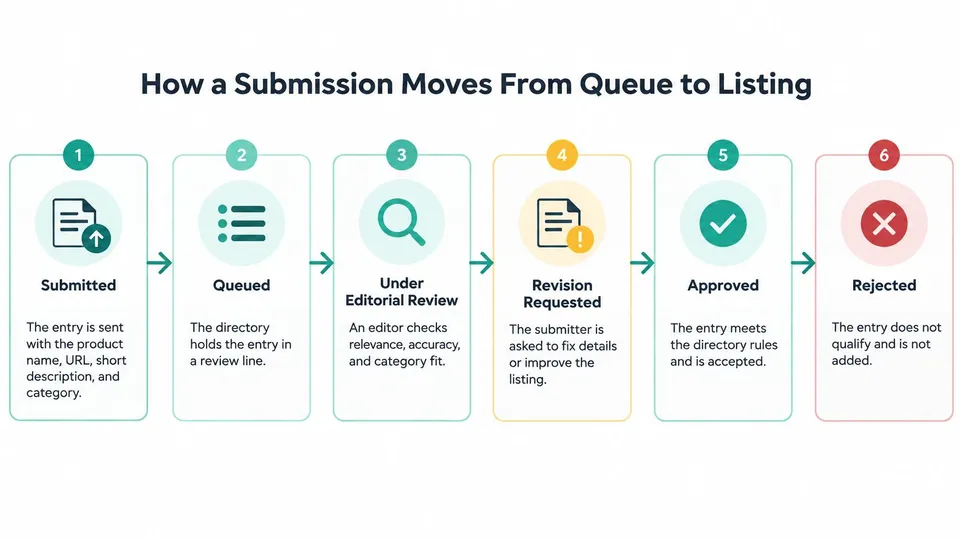
- Submitted. The entry goes out with the product name, URL, short description and category. Save the confirmation email or screenshot immediately, because that's the only proof the form went through.
- Queued. The directory holds the entry in a review line. Nothing is wrong at this stage, and sending a second submission usually creates a duplicate rather than speeding anything up.
- Under editorial review. A person checks relevance, accuracy and category fit. A vague description or a broken URL can cost the listing.
- Revision requested. The editor asks for a fix, often a shorter description, a different category or a working image. Correct the field and resubmit through the same channel.
- Approved. The entry meets the directory's rules and goes live. Open the published page, check the link and confirm the details survived publication.
- Rejected. The entry doesn't qualify. Some rejections are fixable, such as a wrong category. Others are editorial decisions the directory makes on its own, and no amount of polishing changes them.
Three Directories, Three Different Clocks
Say a founder submits a note-taking AI app to three directories on a Monday. The first approves within hours because a moderator is online. The second asks on Thursday for a tighter description, and the listing goes live the following week. The third stays quiet for a month, then declines because the product sits outside its scope.
That spread is normal. Some directories approve listings within hours, others take weeks, and a directory may decline a listing at its discretion. Plan for a portion of submissions to fail, and treat each approval as a small win rather than an entitlement. Founders comparing this with submitting a site to search engines should expect a very different rhythm, since a human queue doesn't behave like a crawler.
Tracking habit: Record the directory name, date sent, current status and the live listing URL the moment it appears.
Keep that in one spreadsheet with the login email for each site. Without it, approvals get lost in an inbox and nobody notices when a listing disappears.
Why Founders Submit and What It Really Returns
Directory submission works like cataloguing a product in a public library. The founder adds a clear record, the directory decides whether it belongs, and readers use the catalogue to find something useful. The return depends on the catalogue being visited, maintained and easy to understand.
Discovery by people browsing categories. This works when the directory has visible, active users. A catalog with filters, search and regular additions gets browsed. A site with no updates and thin pages won't send anyone, no matter how clean the listing looks.
Referral visits when someone clicks. Expect modest numbers that vary widely from directory to directory. A focused catalog where buyers compare tools can send a visitor who's ready to try something. A general list where the entry sits deep in a category sends close to nothing.
Use a distinct link or landing page for each directory campaign, then check which ones bring visits and signups. That gives a clearer answer than counting submitted forms.
A relevant link that helps search systems understand the product. Google's explanation of how Search works describes Googlebot fetching and parsing links, then adding discovered URLs to a crawl queue, and notes that links generated only after client-side JavaScript may be discovered later. A standard href link in the initial HTML of a publicly reachable page gives crawlers a shorter path to a new product page. Check how the directory renders its outbound links, and confirm the listing exists.
For a SaaS company with a public business identity, there's a fourth return worth counting. Moz's guide to local citations describes citations as mentions of a business's name, address and phone number across directories, apps and social platforms, and states that high-quality basic citations can help a business rank accurately in Google's local search interfaces. Treat those records as data assets to keep correct, not just link slots to fill.
A developer tool listed in a small set of active engineering catalogs may get fewer submissions than one scattered across unrelated lists, yet the first set is easier to learn from. Each entry has a clear audience, a visible status and a page that can be checked. Add up directory visits, clicks from tracked links and signups, then compare that with the time spent preparing each listing.
No submission guarantees approval, timing or ranking, and no service can promise those either. Directory approval follows each directory's own schedule, and some directories decline listings at their discretion. What this work can provide is accurate placement in catalogs people use. Measure it by listings that are live, accurate and visited.
Telling a Legitimate Directory From a Link Scheme
A legitimate listing helps a person find a product. A link scheme exists mainly to pass links. The difference shows up in six places, and all six are checkable in a few minutes.
| Signal | Healthy Sign | Warning Sign |
|---|---|---|
| Relevance | Focused on AI tools, SaaS or your niche | Accepts any product in any category |
| Editing | Human review with visible listing standards | Listings publish instantly with no review |
| Indexing | Listing pages appear in search results | Listing pages are blocked, missing or thin |
| Link requirements | No reciprocal or keyword-stuffed link needed | Asks you to link back or pay for a link |
| Ownership | Named team and working contact details | No owner, no contact and no policy page |
| Listing copy | Your own description for each site | The same text pasted into every directory |
Reading the Signals
Relevance and editing travel together. A directory with a narrow scope and published submission standards has a reason to reject weak entries, which is exactly what makes its approvals worth something. A site that accepts everything, instantly, has no editorial product to protect.
Indexing is the practical test. Search for a few existing listing pages and see whether they show up. If they're blocked, missing or one line long, the page hosting your entry probably won't do much either. Ownership is the trust check: a named team and a working contact address mean someone answers when a listing breaks.
Google's spam policies classify links from low-quality directory or bookmark sites as link spam when used to manipulate search rankings, and list buying or selling links for ranking purposes as link spam too. That's the line. A directory can still support discovery and referral traffic, but submitting identical entries broadly just to collect links creates risk rather than value. Anyone building a wider backlink plan should apply the same relevance test to every placement.
Check Upkeep Before Submitting
A listing is only useful while someone maintains the catalog. A historical study of online history resources, cited in this overview of web directories, found that six of nine U.S.-history web gateways were dead or outdated, which shows inclusion never ensured lasting accuracy or availability. Confirm the directory still adds, edits and removes entries before spending time on a form.
A repeatable routine takes about five minutes per site:
- Open the directory and find a live listing page in your category.
- Look for standards, an editor contact or a submission policy page.
- Read the requirements and skip any site demanding a reciprocal link or keyword-stuffed copy.
- Check recent activity, since a catalog untouched for years won't send visitors.
Practical rule: A small set of relevant, maintained listings beats a large set of identical ones.
Decide Whether to Submit Yourself or Use a Service
Doing it yourself is often the better option, and that deserves a plain statement. A founder with ten carefully chosen targets, a free afternoon and a spreadsheet can prepare custom fields, create accounts and track statuses without paying anyone. That route also gives full control over every word in every listing, which matters while product positioning is still shifting week to week.
The cost is time, and it is real time: adapting descriptions to each form's limits, exporting images at requested sizes, creating accounts, chasing confirmations and logging outcomes. Multiply that by a few dozen directories and the job stops being an afternoon.
Paying a service buys back those hours. It does not buy better judgment about which directories deserve the listing, and it cannot buy approval, since each directory reviews submissions on its own schedule.
| Work or Guarantee | Doing It Yourself | Managed Service |
|---|---|---|
| Form work per directory | You adapt fields and descriptions for each site | The service handles the form work |
| Accounts and tracking | You create accounts and track every status | The service returns a report with a spreadsheet of directories and statuses, verification screenshots and login details |
| Listing ownership | You keep full control of every listing | Listings stay the customer's to edit |
| Fixable rejections | You fix and resubmit each one | Fixable rejections are resubmitted at no charge under the service's policy |
| Guarantees | Whatever standard you set for yourself | Manual submission plus a report; approval, timing, domain rating changes and visibility in AI assistants stay outside any provider's control |
Free AI Directories runs a manual service in this space: submissions are done by hand, each order ends with a report listing every directory and its status plus verification screenshots and login credentials, and fixable rejections are resubmitted free of charge. It does not promise a directory's approval, timing or continued publication, because no provider controls another site's editorial queue. Founders comparing how managed packages are structured can browse directory submission options to see what reporting and ownership terms look like elsewhere.
Whichever route fits, measure the result by listings that are live, accurate and visited. Confirm each one on the directory's own page, since a status column in any spreadsheet only records that a form was sent. Ten relevant targets and a spare day points to doing it yourself. A long list and a launch deadline points to handing over the form work.
Free AI Directories maintains a searchable database of AI directories with current domain rating, dofollow and free-versus-paid details, plus a manual submission service that adapts each listing to the directory's format and returns a report with proof of every submission. Start by checking a shortlist of relevant directories against the signals above, then decide whether the form work is worth your own hours. Visit Free AI Directories to browse the directory data and see how a documented submission round works.
Ready to list your AI tool?
Get your tool in front of users across hundreds of AI directories.
Submit Your Tool →