AI Agent Directory: 8 Places to List Your Tool in 2026
An AI agent directory can bring users and backlinks. Compare 8 places to list your AI tool, with submission tips and honest trade-offs for founders.
By Free AI Directories Team · November 19, 2026
Where do users find a new AI tool? Rarely on the first page of Google, and rarely in a launch post nobody shared. Discovery is scattered, and an AI agent directory remains one of the few places where a founder can be found by someone who is already looking.
The supply side explains why. Grand View Research estimated the worldwide AI-agents market at USD 7.6 billion in 2025 and projected it would reach USD 182.9 billion by 2033, a 49.6% compound annual growth rate from 2026 through 2033 (Grand View Research). More products mean more categories, more comparison shopping, and more places that index them.
Demand is mixed. The Stack Overflow 2025 Developer Survey, covering 49,009 respondents from 177 countries, found 30.9% of developers use AI agents at work at least monthly, while 37.9% said they don't use agents and don't plan to. A listing has to serve the active user and the person still deciding.
Eight places follow, with what each one is good for, how the submission works, and where it falls short. The work is repetitive and easy to underestimate. Before treating any listing as a ranking signal, read measuring which links actually move rankings.
Table of Contents
- 1. There's An AI For That
- 2. Futurepedia
- 3. Future Tools
- 4. Toolify
- 5. Product Hunt
- 6. Hugging Face Spaces
- 7. G2
- 8. Capterra
- 8 Places to List Your AI Tool at a Glance
- Pick a Starting Point and Get Listed
1. There's An AI For That
Users often picture this site when they type "AI agent directory" into a search bar. Visitors arrive with a job in mind, browse by task or category, read a short description, and click through to the tool. That intent is the whole value: someone hunting for a contract-summary tool is much closer to signing up than someone scrolling a feed.
Listings are reviewed before they appear, so expect a wait, and read the current submission guidelines before preparing anything.

Write for the Task, Not the Product
Say a founder ships an agent that turns support tickets into draft help-center articles. The line that earns a click reads "turns support tickets into draft help-center articles." The line that gets skipped reads "AI-powered customer experience platform." Same product, different job.
- Name the job first: lead with the task, then mention the technology behind it.
- Use a current screenshot: an old interface signals an abandoned product.
- Choose the narrowest category: broad shelves bury you among hundreds of neighbors.
PwC's 2025 survey of 308 U.S. business executives found 79% of companies surveyed said AI agents were already being adopted (PwC). General directories now receive buyers as well as hobbyists, so the description has to work for both.
Practical rule: if a stranger can't say what your tool does after the first line, the listing failed before the reviewer opened it.
For a wider view of what's available, work through this directory of directories before you start submitting.
2. Futurepedia
Futurepedia sorts tools by category and use case, and each tool page carries a description plus a summary of features. The audience is usually comparing two or three options inside one area rather than browsing for novelty, which makes category placement the most important decision on the form.
That audience is growing in a specific way. In 2025, 82% of executives at large enterprises said their organizations planned to integrate AI agents within the next one to three years, according to a Capgemini survey cited in Google Cloud's AI Trends Report. Plans are not deployments, but plans produce comparison shopping.
Match the Category to the Search
A scheduling agent filed under "Productivity" competes with everything. Filed under "meeting scheduling," it sits in a shortlist. Pick the shelf a buyer would walk to, not the label your team uses in planning meetings.
- Mirror buyer language: use the words people type into a search box, not internal codenames.
- Keep the copy factual: describe what the tool does and who it's for, and cut the superlatives.
- Confirm the process before you build assets: editorial standards and submission steps change, so check the live guidelines first.
Superlatives read as noise. A page that claims "fastest" invites doubt. A page that states "runs on your own infrastructure" invites a question you can answer.
The listing is a summary, not a landing page. Everything that needs a paragraph of explanation belongs on your own site, one click away.
3. Future Tools
Some directories serve problem-solvers. Future Tools serves browsers. It lists products with short descriptions and category tags, and people use it to get a quick read on what's new rather than to solve one narrow problem. For a founder, that means discovery among people who like trying things early.
Treat it as one channel among several. Reach and listing terms shift, so judge a directory by the page your listing lands on rather than by a domain-level score.
Judge the Page, Not the Score
A large Ahrefs study of link data compared the top 10 results for 44,589 non-branded keywords with monthly search volumes between 2,000 and 5,000. It found the total organic traffic of referring pages correlated more strongly with rankings than the number of referring pages that had traffic. The authors were explicit that this is correlation, not proof of cause, and that no single link metric settles the question. The practical read is simple: a relevant, visited page beats a big number.
- Keep the summary to a few sentences: lead with the core benefit, then one concrete capability.
- Update after a major release: an entry describing last quarter's product misleads the people who click.
- Check it on a phone: most browsing happens there, and a broken page wastes the visit.
A founder who ships a big feature and never revisits the entry ends up advertising an older product to the exact audience most likely to try the new one.
4. Toolify
Toolify mixes category pages, tool profiles and ranking-style lists, so visitors arrive both to browse by function and to see who sits on top. That ranking format helps when a product is genuinely differentiated. It's a weaker reason to submit.
Verify the terms yourself before applying, including whether links on the listing are followed. Assume nothing about traffic or link value until you've looked at the live page.
Check the Live Page, Not the Pitch
Google's spam policy treats low-quality directory or bookmark-site links as link spam when they exist mainly to manipulate rankings, and it also lists automated programs or services that create links as link spam (Google Search Central). The same policy says paid or sponsored links can be acceptable when they carry qualifying attributes such as rel="nofollow" or rel="sponsored". A listing built for discovery can still be worth having. A listing sold as a ranking shortcut is a different product entirely.
- Confirm the page is indexed: search the site for your listing URL a few weeks after it goes live.
- Keep product names identical everywhere: the same name on every listing makes comparison and tracking possible.
- Read competitor listings: the categories they chose tell you where the attention is.
Say a founder checks three weeks later and finds the listing live but excluded from search results. That's a placement, not a discovery channel, and it's worth knowing before paying for more of them.
5. Product Hunt
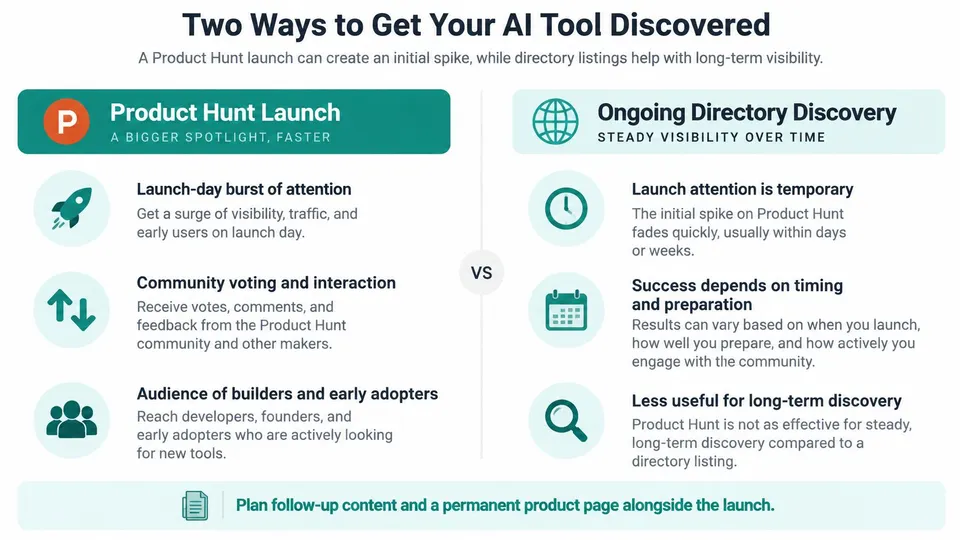
Product Hunt isn't only an AI directory, but it has a large AI section and a habit of producing a spike of attention when a maker launches. The spike is real and short. What lasts is the permanent product page and whatever the launch pushes into other channels.
Plan the follow-up before launch day, or all that traffic lands on a homepage nobody updated.
Launch Day Is the Start
Backlink counting is one place founders mislead themselves. Backlinks count every link pointing at a target, while referring domains count the unique websites holding at least one link (Ahrefs backlink metrics). Three listings on one domain add three backlinks and one referring domain. Track both, and record which domain each one came from.
- Prepare the assets early: a clear tagline, gallery images and a short demo, finished before the day.
- Answer every comment: quickly and openly, including the critical ones.
- Link back from your own site: and update the launch page as the product changes.
For the week after, this guide to promoting an app after launch covers the follow-through that decides whether a launch becomes a channel or a memory.
Trade-off: a launch buys attention for a day. The product page, the follow-up post and the directory listings are what keep collecting it.
6. Hugging Face Spaces
Hugging Face Spaces is where developers publish working demos of machine learning and AI applications. It reaches developers and researchers rather than general consumers, so it rewards a different kind of listing: something people can run, inspect and try to break.
A static description does little here. A demo that loads in seconds does a lot.

Keep the Demo Alive
Discovery is becoming machine-readable. Research on agent discovery proposes evaluating agents through metadata completeness, lookup complexity and transaction performance, with discovery metadata potentially fitting into a single DNS response and being retrieved in milliseconds (Verisign). That's the direction technical buyers are moving. For now, a working demo plus a clear README is the closest many teams get.
- Write a short README: what the demo does, what it doesn't do, and which model or data it uses.
- Link the demo to the product: one obvious path from the demo page to your main site.
- Keep it running: a demo that errors on load is worse than no demo at all.
Say a researcher opens a demo, gets a timeout, and closes the tab. The listing did its job and the product lost the visitor at the last step.
7. G2
G2 is a review platform, and reviews accumulate far more slowly than listings. Buyers read them during evaluation, compare products side by side, and shortlist from what they find. For a B2B founder, a complete profile with genuine reviews is a credibility asset that can't be bought or rushed.
The questions buyers bring are increasingly about control. Sailpoint's research found 82% of surveyed organizations already use AI agents, while only 44% have policies to secure them (Sailpoint). Anyone evaluating your agent has probably been asked where it can act and what stops it.
Answer the Security Question First
Put permissions, data access, human-approval steps and deployment model in the profile before anyone asks. A review platform is a strange place to hide that information, and yet most profiles do.
- Fill every section: screenshots, integrations, pricing if you publish it, and deployment options.
- Ask for honest reviews: from customers who use the product, and follow the platform's rules on how to ask.
- Respond to reviews: politely and factually, including the negative ones.
A review profile and a link profile are different assets with different timelines. If search visibility is the goal rather than buyer trust, the guide to getting backlinks is the more relevant read.
8. Capterra
Capterra, owned by Gartner, lists business software across many categories, AI tools among them. Buyers use feature lists and reviews to compare vendors, then shortlist. A complete listing helps at the shortlist stage, which is late enough that a thin profile costs real money.
Buyers arrive from every stage of adoption. McKinsey's 2025 global survey found that 62% of respondents said their organizations were at least experimenting with AI agents, while 23% reported scaling an agentic AI system somewhere in the enterprise (McKinsey). Your listing has to work for the team running a pilot and the team replacing one.
Pick Categories Buyers Browse
A general "AI" category puts you beside everything. A category named for the function, such as customer support or document processing, puts you beside the tools a buyer is weighing.
- Match business search terms: use the vocabulary procurement teams type.
- Keep features current: a stale feature list creates support tickets before the sale.
- Ask for reviews after onboarding: a short follow-up once the customer is live converts better than a campaign months later.
Listing costs, review processes and placement rules change, so confirm them on the site before committing budget.
8 Places to List Your AI Tool at a Glance
| Best for | Audience type | Listing format | Main limitation |
|---|---|---|---|
| Broad discovery for consumer-facing AI tools | General, mostly non-technical users | Task- and category-based profiles with descriptions and links | Competitive listings and approval review |
| Reaching users comparing tools by category | Users researching specific AI use cases | Category-organized tool pages with feature summaries | Visibility varies across a large listing pool |
| Introducing new AI tools to curious users | People exploring new products | Curated listings with category tags and short summaries | Editorial selection and limited listing detail |
| Discovery and comparison across AI tool categories | Visitors comparing tools by function | Category pages, tool profiles, and ranking-style lists | Placement varies, and backlink value is uncertain |
| Generating launch-day awareness and feedback | Developers, founders, and early adopters | Timed product launch page with votes and comments | Attention is temporary and success requires preparation |
| Showcasing a working AI demo | Developers and researchers | Hosted interactive demos linked to models and documentation | Requires technical setup and maintenance |
| Building credibility with business software buyers | B2B buyers evaluating vendors | Vendor profiles with customer reviews and ratings | Genuine reviews take time to collect |
| Helping businesses compare software vendors | Business software buyers | Vendor profiles with feature lists, filters, and reviews | Listing and advertising terms may change |
Pick a Starting Point and Get Listed
Two or three directories that match your audience beat twenty that don't. A consumer tool with one clear job belongs on task-based directories. A product sold to operations teams belongs on review platforms where buyers compare vendors. Submitting everywhere spreads the same thin description across places that were never going to send a click.
Prepare once, submit many times. One folder holding the logo, a current screenshot, a 30-word description, a 100-word description, a feature list and the security details saves hours per listing. It also prevents the mistake of writing a fresh description at midnight and publishing something vague.
Then track everything. A simple sheet with the directory, the date submitted, the login used, the status, the live URL and whether the link is followed answers the questions that arrive three months later. Without it, nobody can tell what was submitted, what got rejected, or what needs fixing.
The list itself is the part most founders underestimate. Free AI Directories maintains a searchable database of 450+ curated directories with domain rating and free-versus-paid data, built after testing more than 1,000 directories through real submissions. Founders who would rather not spend a week filling forms can use its done-for-you human submissions starting from $99, with a full report and listing credentials handed over. No service, this one included, can guarantee approval, timing or ranking. It can guarantee the work gets done and documented.
Descriptions also age as the product changes. If your tool now runs multi-step tasks, understanding how agentic AI workflows operate helps you describe it in the words buyers search for, rather than the words your roadmap used six months ago.
Start at zero cost if the budget is tight. Free AI Directories offers a free listing option through its Free List link, which is the cheapest way to test whether directory traffic converts for your product before you spend anything on submissions.
Free AI Directories keeps a searchable database of 450+ curated AI directories, each with domain rating and free or paid status, so you can see which places are worth your time before filling in a single form. For founders who would rather ship product than copy descriptions into submission boxes, it also runs manual, human submissions with a full report and login credentials handed over at the end. Start with a free account at Free AI Directories and work out which eight places turn into your next hundred users.
Ready to list your AI tool?
Get your tool in front of users across hundreds of AI directories.
Submit Your Tool →